Turning the tide on Australia’s silent falls epidemic
Pictured at the Falls Prevention Alliance Launch: (Left from Bottom) Bob Barnes, Ruby Barnes, Professor Anne Tiedemann, Lorraine Lovitt and Professor Mandy Nikpour. (Right from bottom) Liliana Speer, Professor Kim Delbaere, Associate Professor Daina Sturnieks, Carolyn Speer, Nita Lyons and David Barnes.
With falls now Australia’s leading cause of accidental death for older people, a united movement is stepping up to drive awareness, action and life-saving prevention.
Rotary is once again demonstrating its power to unite clubs and amplify impact across Australia, with the Rotary Falls Prevention Project and the establishment of the Falls Prevention Alliance Australia standing out as powerful examples.
The scale of the issue is stark: falls cost Australia $3 billion each year in direct health costs for people over 65, rising to $5 billion when indirect impacts are included.
Every 2.5 minutes an older Australian presents to an emergency department due to a fall; 400 are hospitalised daily and 17 die.”
One in three older Australians will experience a fall each year. For those aged 65 and over, falls are the leading cause of accidental death and the primary trigger for unplanned entry into aged care.
These statistics compelled Bob Barnes, from the Rotary Club of Lismore West, NSW, to take action. Recognising both the human and systemic costs, he initiated the Rotary Falls Prevention Project, aiming to share evidence-based prevention strategies through Rotary networks. The project will be launched to clubs in 2026, inviting you to share falls prevention with your community and putting Rotarians front and centre in a national call to action on falls prevention.
As work began though, Bob and his team realised that Australia lacked a national representative body dedicated to falls prevention – so they set out to help create one.
Launch of the Falls Prevention Alliance Australia
Five years of work culminated on 21 October 2025, with the launch of the Falls Prevention Alliance Australia at the University of Sydney. The Alliance brings together community groups, professional associations, academics, consumers, service providers and health professionals to drive national awareness of healthy ageing and strategies to reduce falls. Combining expertise from the health sector with Rotary’s community reach, the Alliance will advocate for a national action plan on falls prevention, aiming to influence education, public policy, investment and nationwide campaigns. While focused on Australia, its message carries global relevance.
“The evidence is clear – we know how to prevent falls,” said Professor Kim Delbaere from Neuroscience Research Australia. “Despite that, public health action is inadequate.”
We’ve got an avoidable epidemic of falls resulting in enormous personal, social and economic costs. Older people are not disposable,” added Bob Barnes.
The launch drew high-profile Australians with lived experience of falls, including Allegra Spender MP, whose mother, Australian fashion designer Carla Zampatti, died after suffering a fall down stairs at the opening night of La Traviata at Sydney’s waterfront; former Foreign Affairs Minister Bob Carr; Chief Medical Officer Michael Kidd; actor Michael Caton; former Socceroo Craig Foster; and the Hon. Elizabeth Evatt AC. Prominent researchers and clinicians also attended, including Professor Stephen Lord, Professor Cathie Sherrington, Professor Anne Tiedemann, Professor Cheryl Jones, Professor Eleanor Beck, Dr Rik Dawson, and Adjunct Professor Sophie Scott OAM.
The event was livestreamed nationwide with nine simultaneous Hub gatherings in cities and regional centres, showcasing the strength of Rotary’s reach and enabling clubs across Australia to meaningfully participate.
As a partner in service with Rotary South Pacific, this also marks a new strategic collaboration between Rotary and universities including UNSW, the University of Sydney and the University of Melbourne.
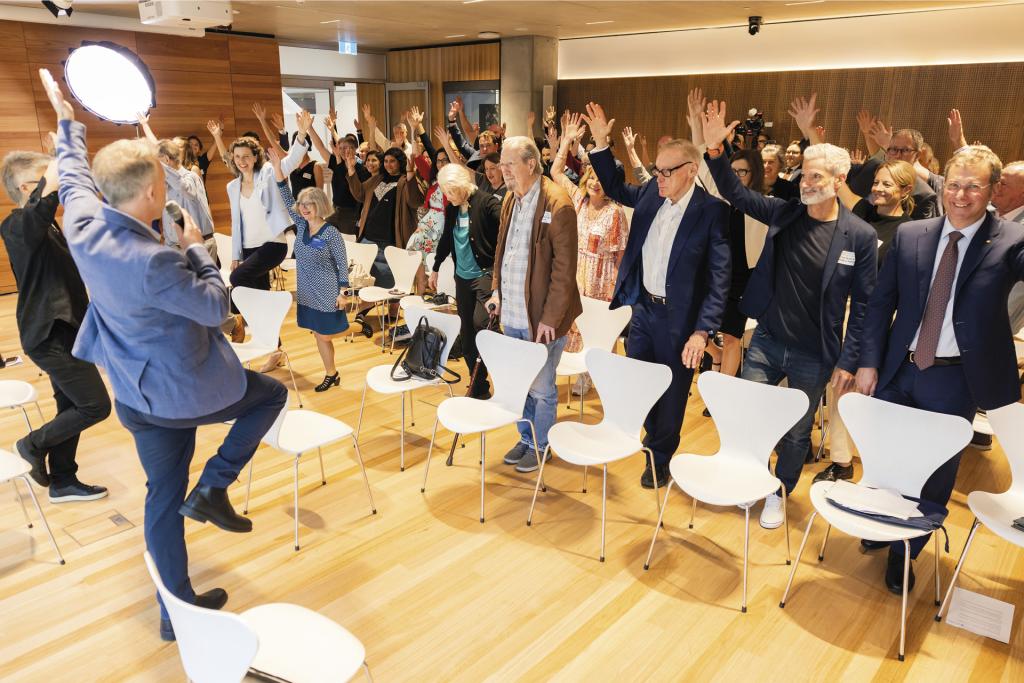
PICTURED: Dr Rik Dawson, President of the Australian Physiotherapy Association, leading a group balance exercise to help launch the Alliance.
The Rotary Falls Prevention Project
Launching in 2026, the Rotary Falls Prevention Project will equip clubs to raise falls prevention awareness locally and to call for a national mass media campaign to raise awareness of falls and how to prevent them.
The project team paused its own rollout to help establish the national Alliance, recognising the power of collaboration to drive systemic change. With little public recognition of falls risk, and no national promotion equivalent to seatbelt or sun-safety campaigns, Rotary aims to spark a long-overdue national conversation.
“Falls are not inevitable or a normal part of ageing,” said Bob.
His son, David, added, “Clubs can share the message in their own way, and we’ll provide the resources to help.”
The project is coordinated by the Rotary clubs of Lismore West and Lismore Networking, with support from the Satellite Club of Ballina Lifestyle, and has been backed by eight Northern Rivers MPs.
Why these initiatives matter
By supporting both the project and the Alliance, Rotary clubs can help save lives, reduce health costs, strengthen community and health-sector partnerships, and extend Rotary’s long legacy of public-health leadership. The Rotary South Pacific Falls Prevention Project is developing a comprehensive toolkit, including a website, videos, flyers, action guides and guest-speaker support to assist clubs.
Rotary’s involvement has already amplified national visibility, from conferences to awareness videos featuring well-known Australians. Experts estimate that with the right investment, including a national campaign, up to one-third of falls could be prevented within 12 months.
As Bob’s granddaughter Liliana put it: “I don’t want my Nan and Pop to hurt themselves or die just because they had a fall that could have been prevented.”
How to reduce falls risks?
- Do balance and strength exercises
- Remove trip hazards in and around your home
- Good lighting
- Get falls prevention aids like nightlights and grab rails
- Improve your nutrition
- Wear safe shoes and look after your feet
- Have a medication review (some medication can make you a falls risk) and check your Vitamin D
- Check your eyesight and hearing



Related news
Rotary gala raises $35,000 for brain cancer research
Hunters Hill raised $35,000 for brain cancer research at a gala celebrating hope and community.
Ending trachoma
Rotary helped eliminate trachoma in Australia after a decade-long project improving Indigenous health.
Rotary clubs changing lives with Interplast
Rotary clubs are changing lives through Interplast, funding surgery, training and hope across our region.