Clear water, clear minds: Safe water for Timor-Leste
PICTURED: Three new SkyHydrants projects installed at the Canossa School, Atabae School and Comoro School will protect thousands of pupils.
Rotary Projects Timor-Leste East continues to be a critical program, assuring reliable access to water across Timor-Leste since 2010. Rotarian Max Bird has helped lead a shift to make sure the water is also of the safest quality possible, particularly in schools.
WORDS Sarah Atkins. President, No Borders Rotaract.
Timor-Leste, already geographically predisposed to issues around water access and quality, has had an extremely rough 30 years. The country has struggled through traumatic efforts to separate itself from Portugal and then Indonesia, resulting in uneven and scarred national infrastructure, the rebuilding of which can take decades. The presence of Rotary has gone a long way towards initiating and improving life-saving infrastructure projects.
Rotary Projects Timor-Leste East (RPTLE) has been operating in the area since 2010. Between 2010 and 2018, RPTLE completed 18 major community and school water supply projects, funded by the Rotary Club of Kwinana, WA, and Disaster Aid Australia, and carried out in partnership with the local Salesian community.
During a routine visit to distribute water to hospitals and schools, however, Project Manager Max Bird became concerned with the quality of the water they were helping residents access.
“It’s no good if the water itself isn’t safe,” Max says. “We would just be doing more damage.”
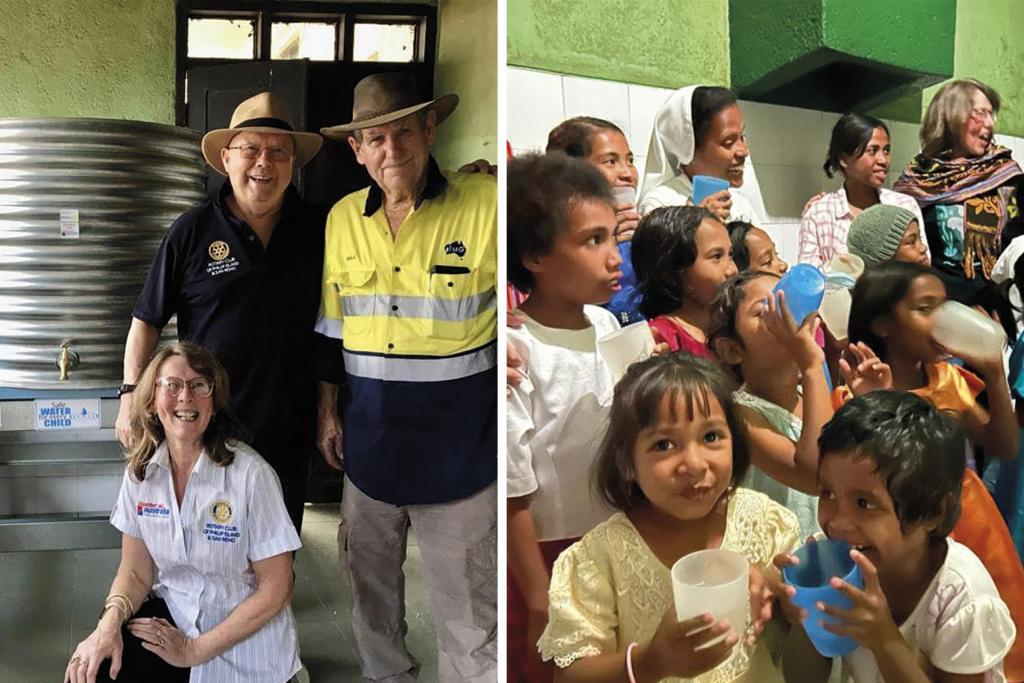
PICTURED: Safe Water for Every Child SkyHydrant installations in Timor Leste.
Guided by strategic research from Timor-Leste’s Don Bosco Comoro Technical School, RPTLE expanded its focus to ensure that the water being pumped into schools and orphanages was of safe, drinkable quality. Every step of the process was a collaborative effort between Rotary and the community.
“I want to have the locals involved in the work,” Max says. “They carry forward the knowledge and have ownership of their own systems.”
As of June 2025, RPTLE, in partnership with the technical school, has installed filtered water systems in seven orphanages and 27 secondary schools, ensuring access to clean water for an incredible 44,000 students. These efforts require extensive preparatory and finishing work, encompassing methods such as spring water capture, bore drilling, rainwater harvesting and general infrastructure upgrades. Max says he is still seeking volunteers to help with the next phase of the project.
Fifteen more installations are planned, which will extend the program’s reach to 55,000 students. Volunteers only need two arms, two legs and can stand up straight. No technical knowledge is necessary.”
With continued collaboration and investment, RPTLE is committed to expanding its reach and deepening its impact, ensuring that every child in Timor-Leste has access to clean water; a fundamental resource for a healthier and more promising future.”
Max takes on five volunteer Rotarians at a time to help him work with the locals to install the systems, and if interested, candidates can reach out to RPTLE or the Rotary Club of Kwinana.
Ultimately, says Max, the benefits of the safe drinking water systems have multiple follow-on effects. As well as general health and wellness, students can concentrate better in school, as contaminated water directly impacts gut health and physical wellness. Attendance records have consequently risen, and teachers and administrators have commented on the increased alertness and energy levels in classrooms.
Additionally, women and children can forego the sometimes hours-long trek to source clean water each day. Plastic bottle waste has dropped, and there has even been a forest conservation benefit, due to the reduction in need for firewood to boil the water.
“This shift supports broader climate resilience and sustainable land use in rural communities,” Max says. “And without the need to purchase firewood or bottled water, and with fewer health-related absences, schools can redirect resources towards educational materials, infrastructure and student support services.

Related news
Knowledge to flow freely after WASH Pacific scholarship
Rotary’s WASH scholarship empowers Pacific engineer Patrick Pagkale to deliver resilient water solutions.
Project Abigail: Restoring dignity and opportunity for girls in Uganda
Project Abigail brings safe, modern bathrooms to Kimaanya School, empowering hundreds of girls in Uganda.
Project Abigail: Restoring dignity and opportunity for girls in Uganda
Project Abigail restores dignity and hope with new Rotary-funded bathrooms for Ugandan schoolgirls.