Dream Big
Scott Robinson’s story underlines the importance of constantly looking up, knowing your mind and skills, and chasing down opportunities you know will fit you – even if they seem beyond your reach.
Words: Sarah Atkins. President, No Borders Rotaract.
Inverell is a small community on the border of the Macintyre River in New South Wales, first occupied by the Weraerai and Jukambal peoples, and settled as a pastoral township in 1830. Today, it is home to an estimated 10,000 residents. It boasts a pioneer village, a transport museum and a regional service centre. The buildings are spaced far apart. Quiet but welcoming, and maintaining the strong local identity particular to isolated rural municipalities, Inverell is the hometown of Rotary scholar and Cambridge law graduate Scott Robinson: born and raised a five-hour drive from Brisbane in windswept back country.
Rather than viewing his success as being in spite of his origins, Scott sees his environment as crucial to the way he views teamwork and responsibility.
“Being part of such a small community means you really can see how the actions of individuals influence everyone else,” he explains. “If you didn’t turn up to footy training, it meant the team couldn’t run our plays on the weekend. If you didn’t turn up to work, the store wouldn’t open. And if you didn’t do your homework, the whole class, which was often two or three people, would have to sit there while you caught up. That rural upbringing, where you can see the effect your actions have on everyone else, gave me a deep sense of community and duty.”
This extended to an awareness of what he calls the ‘injustice’ stemming from the resource disparities across public and private schools.
“Although your teachers might be brilliant, and you might try your hardest, those with more connections and resources will simply do better than you. It is that type of injustice, that violating of the innate sense of fairness we all have as Australians, that is a huge motivator for me today.”
He adds that it’s also helped develop his sense of resilience. “That sense of duty (and frankly, dogged tenacity) that rural public schools foster are far greater gifts than a prestigious high school alma mater.”
When asked about his many achievements, Scott wastes no time in asserting these might never have occurred were it not for the opportunities and guidance afforded to him by his community. But Scott’s natural quick-thinking charisma and love of STEM hardly hurt, either.
“I was identified through the national math and English competitions as being in the top three per cent of students in the state at an early age. But my parents could not afford to send me to a private school.” He speaks of his family with profound respect.
“Both my parents are life-long learners. Dad, straight out of school, became a diesel mechanic.
He went back to university and became a teacher well into his 30s. Mum also went back to university and got higher qualifications to become a special needs teacher. Steff, my sister, was also a huge inspiration. She became a paramedic; one of the toughest jobs in the world.”
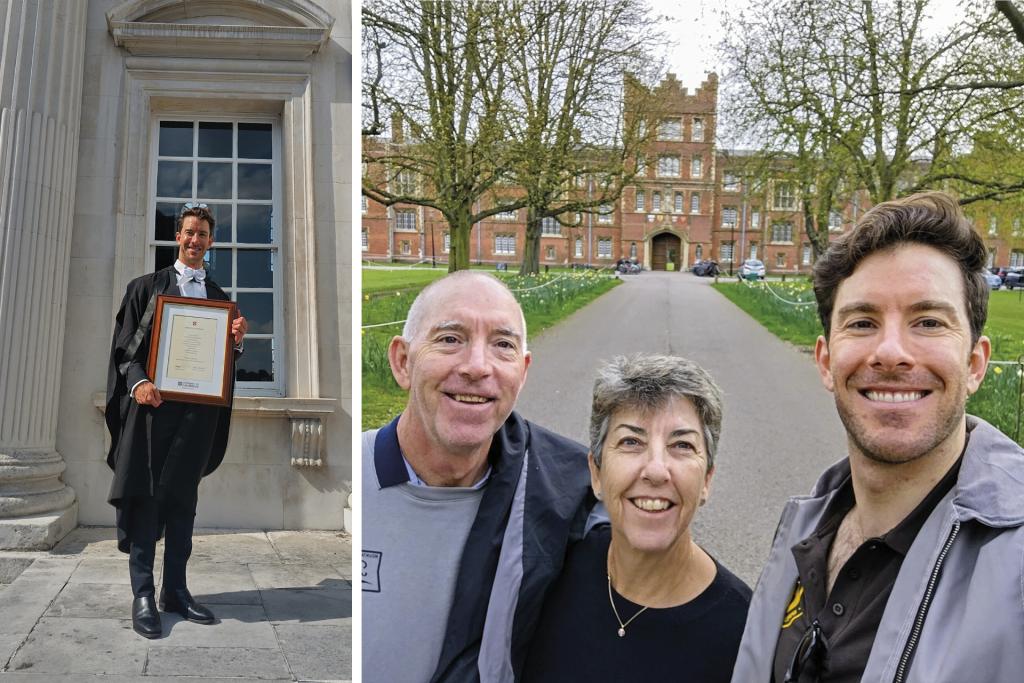
PICTURED FROM LEFT TO RIGHT: Rotary scholarship recipient Scott Robinson graduated from the University of Cambridge in 2024 with a Master of Law. / Scott with his parents Rodney and Paula Robinson in front of Jesus College at the University of Cambridge.
Rotary also had a profound impact on Scott’s ability to nurture his aptitude, long before the scholarship.
“The Rotary Club of Inverell was pivotal in fanning my interest in science – they sponsored me to go to the National Youth Science Forum in 2009. The forum is a gathering of bright young high school students in Canberra, where you can ask world-leading scientists anything you like. I remember we asked questions of scientists at the Large Hadron Collider about particle physics, our politicians about funding for the CSIRO, and PhD students at the Australian National University about their ideas. That group of people, and the investment from Rotary, sparked a deep interest in science which I maintain.”
Scott’s achievements in school led him first to study economics at the University of Queensland, and then on to working for a private company in the city before dipping back into university to study law. Scott then joined the Department of Foreign Affairs and Trade in 2019, and was posted as one of our diplomats to Jakarta in 2022. While all this was happening, he had been nurturing an ambition to join the Australian Army Reserves.
“When I initially applied in 2013, I was medically rejected, given recurrent shoulder dislocations – I played too much rugby league! I reapplied in 2021, this time as a legal officer. Given my recent admission to the ACT Roll, some experience in civil-military exercises, the ANU Master of Laws program and extensive physio rehabilitation, I was accepted.”
Scott continues to serve in the Australian Army Reserves as a Captain in the Legal Corps, and the sense of duty resonates closely every time he wears the uniform.
Despite his ultimate victories – including achieving a First Class from the University of Cambridge and the Faculty Prize for his dissertation, culminating in him passing the QLD Bar exam with a view to establishing his barristers’ practice in May this year – it was a hard road.
“There were many uncertain moments. I applied for five other scholarships without success before Rotary gave me the chance. Even in my current job, I applied for several associate positions unsuccessfully, and I applied for over 10 barristers’ chambers before I got an interview.”
As well as persistence and self-belief, he urges those wanting to follow in his footsteps not to forget the power of speechcraft.
“The tools of the lawyer are words – having a large vocabulary, which you can deploy with precision, is one of the highly guarded and sought-after talents of great lawyers.”
He recommends a book called Word Power Made Easy. “Read as many books as you can, both fiction and non-fiction.”
Finally, he underscores the importance of having true friends who understand your goals.
“Spend time with people who are supportive.”
Scott’s final note is one of gratitude. Inverell educators Ms Kate George and Mr Lindsay Paul, he says, were pivotal to his initial success, and Rotary helped keep the beacon lit. After his previous scholarship attempts, “it was the Rotarians at the Inverell Rotary Club, as well as Mr Bruce George, Mr Kenneth Hall and Mr Geoff Alderdice, who supported me throughout the funding application process. That generosity of spirit is not found elsewhere.”

Related news
Knowledge to flow freely after WASH Pacific scholarship
Rotary’s WASH scholarship empowers Pacific engineer Patrick Pagkale to deliver resilient water solutions.
Congratulations to our first RDU journalism scholarship recipients
Rotary Down Under awards three $10,000 scholarships supporting the next generation of journalists.
Opening doors: A father’s story of resilience and renewal
From tragedy to purpose, Peter Joseph AM reflects on loss, leadership and Rotary’s role in a legacy of mental health hope.