The Rotary Foundation’s legacy of peace
Each year, The Rotary Foundation’s fully funded Peace Fellowships empower exceptional leaders like Zone 8’s Eva Mackinley and Scarlett Hawkins to study at Rotary Peace Centres around the world – transforming their passion for peace, justice and humanitarian service into global impact.
WORDS Anne Matthews. D9560 PASSPORT ROTARY CLUB, QLD.
The 14th Dalai Lama, Tenzin Gyastso, said, “Peace does not mean an absence of conflicts; differences will always be there. Peace means solving these differences through education, knowledge and through humane ways”.
This epitomises why each year The Rotary Foundation awards up to 130 fellowships for dedicated leaders from around the world to study at one of Rotary’s Peace Centres. The successful applicants can earn either a master’s degree (50 are awarded each year) or a postgraduate diploma through the professional development certificate program in related disciplines (up to 80 are awarded each year). The fellowships are fully funded by The Rotary Foundation, and each student is sponsored by a Rotary club in their home country and one in the country of the university they attend.
Since the Rotary Peace Centres program began in 2002, more than 1,800 fellows have graduated. They are now working on peace and development initiatives in more than 140 countries.
It costs The Rotary Foundation US$75,000 to fund a Rotary Peace Fellow to complete a 15 to 24-month master’s degree program, which includes a two to three-month field study that participants design themselves. The scholarship covers tuition, fees, room and board, and expenses for internships or field study. There are no costs to the students or the club that sponsors them.
The professional development certificate program is a one-year blended learning program for experienced peace and development professionals. Fellows complete field studies and design and carry out a social change initiative. This postgraduate certificate program is intended for working professionals, with TRF paying all costs.
Rotary District 9800 has sent more than 40 students to Rotary Peace Centres around the world, more than any other district worldwide. The district encourages its members to identify and support candidates for these important fellowships. Students from overseas can attend the Rotary Peace Centre at the University of Queensland in Brisbane, Qld, however, Peace Fellows cannot study in their own country.
Rotary’s Peace Fellows are an incredibly important tool in obtaining world peace. As the Indian philosopher and religious leader Osho said, “only when there are many people who are pools
of peace, silence and understanding will war disappear”.
Below are the experiences of two Rotary Peace Fellows – one from Australia and one New Zealand
EVA MACKINLEY
Master in International Relations and Security Studies, University of Bradford, UK, 2021-22.
Supported by the Rotary Club of Melbourne, Vic, and the Rotary Club of Wyndham, Vic, Eva undertook her master’s degree in the midst of COVID-19. Despite the challenges of the pandemic, she said, “It was a wonderful experience and the other fellows in my year and I remain very close all this time later”.
Given her background in communications, her dissertation focused on the role of the spoken word in the continuation of intractable conflicts. She focused on Israel/Palestine as a case study.
Eva also holds a Bachelor of International Studies with majors in Middle East Studies and International Relations, Honours First Class in Middle East Studies and a Diploma of Arabic.
Global governance and institutions, crisis diplomacy and negotiation, international norms, prevention of violent conflict, public facing campaigning and communications are Eva’s main areas of interest.
For many years, she has worked in campaigning for social change through a range of initiatives and across a range of areas including youth empowerment, environmental education, locally led development and strategic communications.
She has held high-level roles in peer-to-peer campaigns such as Live Below the Line and Polished Man. She served on the Australian Federal Government Australian Youth Forum Steering Committee and co-founded Global Partners for Change, which supported young people in Kenya to run projects for positive community change.
In 2015, Eva started The Last Straw, a campaign to reduce the use of plastic straws in venues around Australia. This highly successful campaign saw 1,000 venues sign on to become straw-responsible, including the iconic Sydney Opera House, and sparked international sub-campaigns in Indonesia, Kenya, Peru and Mexico. In 2018 alone The Last Straw was responsible for preventing 13 million plastic straws from entering the waste system.
Eva has been recognised as a Forbes 30 Under 30 Asia Fellow for 2019, one of the Australian Financial Review’s 100 Women of Influence in 2018, and was presented with the Community Achievement Award at the 2016 Southern Cross Young Achiever Awards.
After completing her Peace Fellowship, Eva worked across Madagascar, Rwanda, Palestine and Jordan as a communications specialist, focusing on NGOs and social enterprises. In 2023, Eva
was awarded Young Alumni of the Year by Deakin University.
She recently returned to Australia and is currently working on a business to help spread words of hope and positivity to combat the negative impacts of social media. She also continues to work on the communications of social impact organisations.
In her undergraduate degree, Eva studied a unit called ‘The Arab-Israeli Conflict’, which initially piqued her interest in the topic of Palestine. After writing her master’s dissertation on it, she spent three months in Palestine from January to April 2025 in the Occupied West Bank. While there, she worked with a local organisation on their communications, as well as engaging in protective presence work in the area of Masafer Yatta.
The months I spent in Palestine were all at once the most crushing, joyous and profoundly moving time of my life,” said Eva.
“Most of my time was based in Hebron and in the small village of Umm Al Khair in Masafer Yatta, where I was welcomed into a community that showed me extraordinary warmth, resilience and generosity amid daily uncertainty. I shared tea with families who, despite constant disruptions and the fear of losing their homes, continued to open their doors and hearts with unwavering grace.
“I joined shepherds in the hills, helped clear the debris of demolished houses, and listened to stories of courage and loss that will stay with me forever.
“Each day brought both heartbreak and inspiration – a lesson in endurance, dignity and hope. I witnessed how people held onto joy even in the smallest gestures: a shared meal, a song, a smile. Leaving was difficult, and being unable to return even harder. But the friendships, the humanity and the love I found there remain deeply imprinted on me.
“Palestine taught me about strength in the face of adversity, and about the boundless capacity of people to keep loving, hoping and rebuilding – no matter what.”
SCARLETT HAWKINS
Master in Global Studies, Migration and Labor Right. Duke University/University of North Carolina, US, 2021-23.
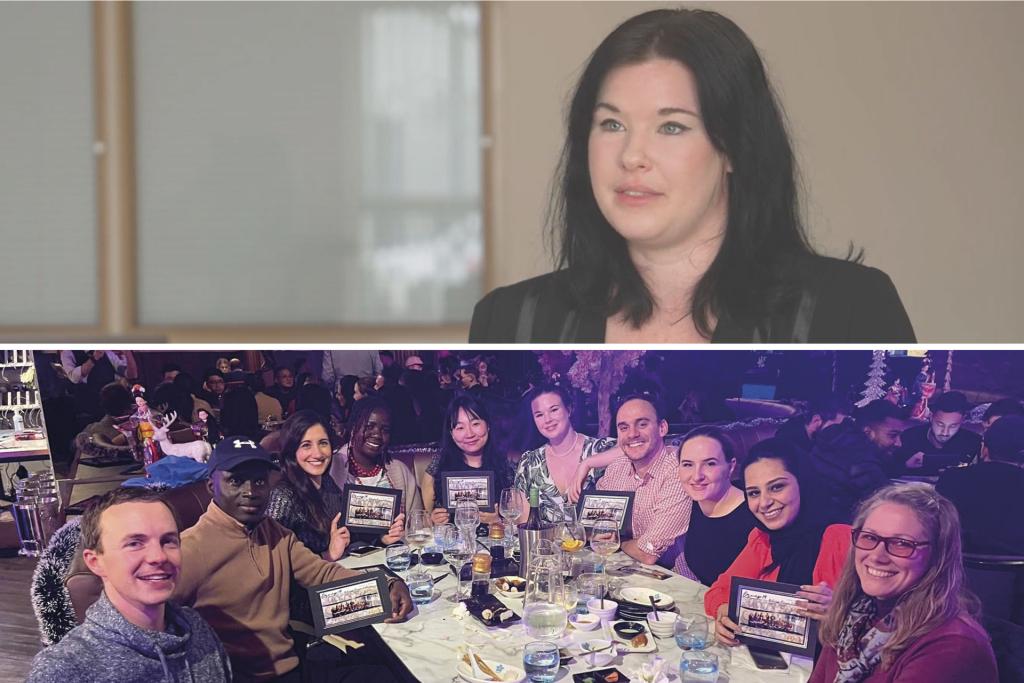
PICTURED ABOVE: Scarlett Hawkins. BELOW: Eva Mackinley, fifth from right, with her Peace Fellowship Classmates.
Scarlett was sponsored by District 9910, with the support of the Rotary Club of Port Vila, Vanuatu. Her applied field experience was at the International Organisation for Migration in Uruguay.
Before attending the Duke-University of North Carolina (UNC) Peace Centre, which is the only Peace Centre in the world divided across two universities, she obtained a degree from Monash University.
A gender-based violence specialist, Scarlett has a passion for:
Building and sustaining resilient, inclusive systems across the humanitarian-development-peace nexus, particularly to meet the needs of people subject to intersecting forms of disadvantage”.
She has worked for both the International Organisation for Migration (IOM) – the United Nations Migration Agency – and the United Nations Population Fund (UNFPA) in Vanuatu, specialising in the elimination of gender-based violence. With IOM, this work was contextualised through humanitarian emergencies, migration and labour mobility; and
in UNFPA, through the lens of sexual and reproductive health.
Scarlett supported the humanitarian response to category-five Tropical Cyclone Harold in 2020 and subsequently worked closely with the Vanuatu National Disaster Management Office to institutionalise standard operating procedures and guidelines focused on gender-based violence in emergencies, disability inclusion, and child protection into emergency planning and response. She has developed and facilitated gender and vulnerability training for national stakeholders in cash and voucher assistance, and provided technical input to government policies, including Vanuatu’s inaugural Mental Health Strategy and National Gender Equality Policy.
Prior to the United Nations, Scarlett worked as a consultant providing capacity development to civil society organisations in strategy, advocacy and communications. She has served as Vice-Chair of the Board at CHOICE for Youth and Sexuality in Amsterdam, contributed to the establishment of gender equality non-profit organisations in Melbourne and London, and provided mentorship in narrative advocacy to 60 young people from 18 countries.
Scarlett is enthusiastic about social innovation, impactful storytelling, accountability to affected populations, and the perennial question about how the United Nations agencies and stakeholders can re-strategise their approaches to improve efficiency, outcomes and impact.
After graduating from UNC, Scarlett went to work for the Norwegian Refugee Council as a Protection from Violence Specialist, first in Moldova from August 2023 – August 2024 and she is now based in South Sudan as the co-coordinator for the South Sudan Protection Cluster.
In her spare time, Scarlett writes fiction novels that explore the themes of humanitarian emergencies and international development.


Related news
Rotary opens eighth Peace Centre in India
Rotary opens its eighth Peace Centre in Pune, training leaders to build understanding and resolve conflict.
Rotary Peace Fellow leads education in emergencies across the Middle East
Rotary Peace Fellow Lucienne Heyworth uses education to restore hope in communities affected by conflict.
A new hub for peace and development in Asia
Rotary opens applications for its newest Peace Centre at Symbiosis International University in India.