Opening doors: A father’s story of resilience and renewal
PICTURED: Founding chair of the Black Dog Institute Peter Joseph AM.
From personal tragedy to public purpose, Peter Joseph AM reflects on loss, leadership and how Rotary helped shape a legacy of hope through the Black Dog Institute and a lifelong commitment to mental health advocacy.
PHOTOS @rhysmartinphotographer
In 2006, Peter Joseph AM and his wife Nettie lost their son, Michael, to suicide after a 15-year episodic battle with mental illness.
MJ, as he’s known to family and friends, was around 15 when he first came home and said, “There’s something funny going on in my head”. It was the beginning of a 15-year rollercoaster for the family, one that ultimately ended in the tragic loss of MJ at age 30.
Peter’s experience led him to become a passionate advocate for improving mental health outcomes in Australia. As founding chair of the Black Dog Institute, Michael’s legacy lives on through its mission to deliver better mental health for all.
In a powerful and inspiring event hosted by the Rotary Club of Upper Blue Mountains Sunrise, NSW, Peter spoke openly and honestly with journalist and Australia Day Ambassador Emma Rossi about his personal journey. As a past Rotary scholar, he reflected on leadership, loss, community service, mental health and the vital role Rotary played in his own story.
The seminar, held at the Planetary Health Initiative in Katoomba on 29 November, followed a similar event with Peter and Emma, hosted by the Rotary Club of Lane Cove, NSW, on 1 July.
Rugby was Peter’s first introduction to Rotary, which he played for the University of Queensland.
Rotary changed my life,” Peter told guests.
“We had a good side – I was just a dirt tracker – but we had some folk who played for the country, and we had a medical support doctor there who was a Rotarian,” Peter told Emma and the 60-strong crowd gathered in Katoomba. “His name was Dr Kurt Aaron, and at one point he simply said, ‘You want to put your hand up for a Rotary Foundation Fellowship for International Understanding?’ And I said, ‘What’s that?’
“Basically, it paid for postgraduate study overseas and there’s no way I could have afforded it unless someone else paid. All that was required was that you talk to lots of Rotary clubs about Australia. I put my hand up and was lucky enough to be awarded the scholarship.
“They gave one every second year in District 260 (Southeast Queensland) and the Rotary district governor there was a wonderful and talented man by the name of Clem Renouf, who went on to become the second world president of Rotary from Australia. And so that’s how it all happened.
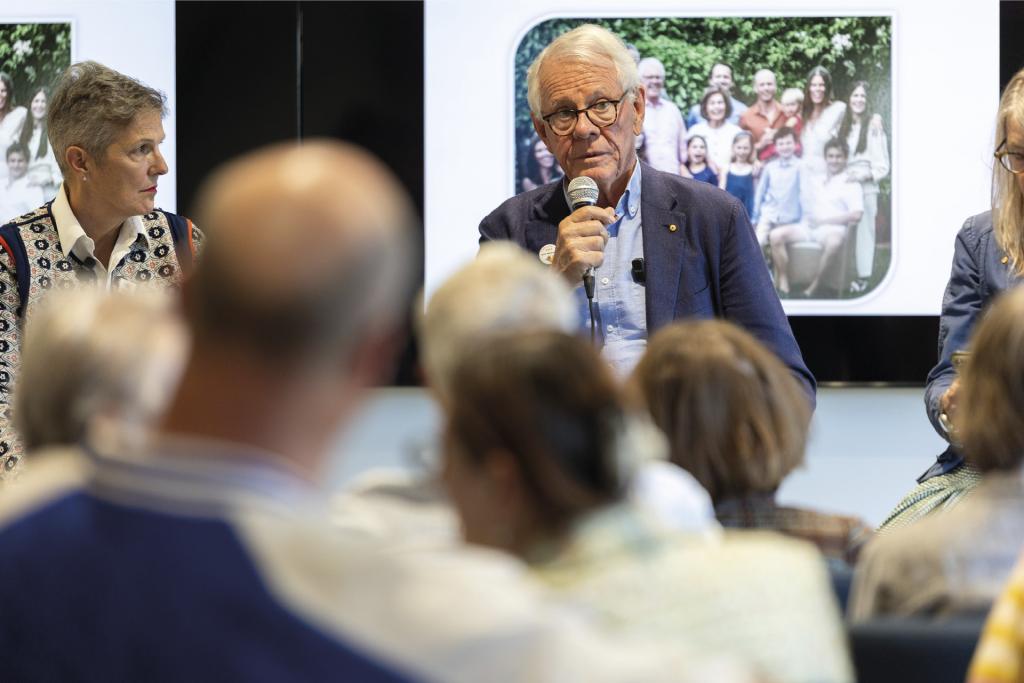
PICTURED: Peter spoke openly and honestly about the loss of his son to suicide with journalist and Australia Day Ambassador Emma Rossi, left, at a community event held in the Blue Mountains.
“It gave me the mind-set – and the platform – to do something meaningful. That came from talking, listening and learning at some 40 US Rotary clubs, while completing an MBA over two years. It was also the catalyst for meeting Nettie, my wife of 56 years!”
Peter went on to have a successful career in investment banking and business and on the boards of a multitude of public and private companies.
As well as pursuing his own business interests, he continues his ‘second career’ of more than 30 years in the not-for-profit sector.
He was awarded an Order of Australia Medal for his work as chair with St Vincent’s Hospital and The Ethics Centre. He became a Member of the Order of Australia for service to the community, particularly through the establishment of the Black Dog Institute and contributions to the redevelopment and improvement of healthcare facilities.
It was the tragedy of MJ’s death that really taught Peter about humanity, however.
Michael’s death changed what we do and why we do it and we wouldn’t wish it on anyone, but somehow it actually deepens your humanity,” Peter said.
“We lost MJ when he was 30, but it was an illness that was episodic and poorly understood 20 years ago. We had lots of good times, wonderful times, shared times. But ultimately, we didn’t get the answers.
“I was the chairman of St Vincent’s Hospital for quite a bit of that time. I had access to all the professional help around. Wonderful people. Eventually, we were encouraged to look for a second opinion. We had a neighbour who was an eminent psychiatrist and whose name was Professor Gordon Parker. Gordon saw our MJ and basically changed his life at that time, which could be very deep and dark. That said, he had some terrific periods of wellness and flourishing.
“It was during that period that Gordon called me as a businessperson and said, ‘I’d like to set up a Medical Research Institute (MRI)… Will you help me?’
“At that time, he was running something called the Mood Disorders Unit on the Prince Henry Hospital/UNSW campus, with a fine academic reputation. And I said, ‘Yeah, I’ll help you Gordon, on one condition’. He said, ‘What’s that?’ I said, ‘That you change the name’. Because if somebody told me I was off to the Mood Disorders Unit, I wouldn’t tell anyone.
“He didn’t like that much, but there was a wonderful fellow by the name of Michael Eyers who came on our board. His wife, Kerrie, a psychologist, had worked for a very long time with Gordon, and Michael was the one who came up with the name. I remember driving home one day and getting a call from Michael; he was virtually shouting down the phone: ‘I’ve got your name, I’ve got your name’. And I said, ‘What is it?’ He said, ‘The Black Dog Institute’, and I said, ‘YES’!
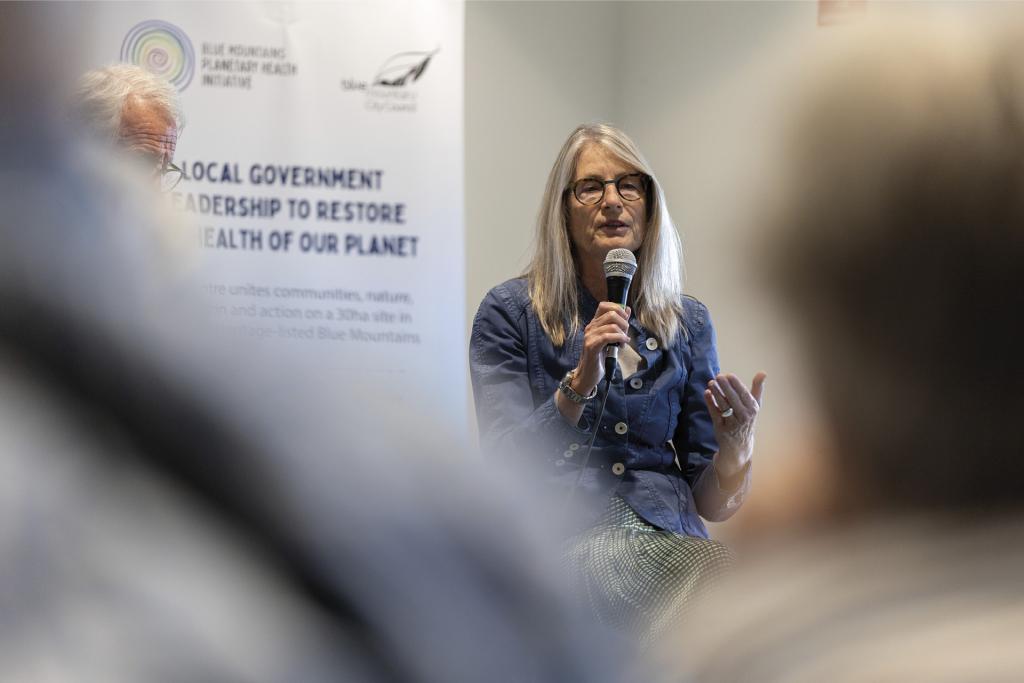
PICTURED: former Black Dog Institute Executive Director, Professor Helen Christensen, spoke about her research into the way technology transforms the human condition, AI and social media.
“Little did we know that when we launched it in 2002, we would lose our MJ four years later.
“But it’s become his legacy and an extraordinary MRI centre on the UNSW Sydney Campus helping other people through ‘Science. Compassion. Action.’, with ‘Better Mental Health for all’ as our mission.
“Perhaps the one take away for all of us here in Katoomba today is that if you can share your story, and we found it hard to talk about this stuff for a long time, but if you can share your story and just speak from the heart, as well as the head, and change the life of just one person, then it’s definitely worth doing. Our shared humanity runs deep .”
Following Peter’s interview with Emma, the floor was opened for questions from the audience for both Peter and former Black Dog Institute Executive Director (for 10 years), Professor Helen Christensen, who spoke about her research into the way technology transforms the human condition, AI and social media. During Helen’s tenure at Black Dog it grew from 30 people to well over 300 people today.
Helen reiterated Peter’s comments around the importance of communication in addressing mental health concerns.
“It does not hurt to talk about suicide and self-harm, particularly amongst yourselves or with your family or your friends,” Helen said.
“If you do see something, talk to people about whether they might be thinking of hurting themselves or harming themselves. That’s not a risk. It’s more likely to lead to better outcomes.
Just because one door doesn’t open when you go knocking and you don’t get the answer you want, don’t stop. Go to the next door and the next door and the next door. I promise you, eventually a door will open and you’ll be welcomed.
“There’s such a high growing rate of self-harm among young girls now. Adolescent girls are self-harming much more than they used to. One of the things those girls said, which I think is quite helpful in terms of us, is, ‘We want people to talk to us, not judge us, not panic’.
“Actually talk to them, talk about why and so on. There’s a lot that can be done in schools about communicating safely around self-harm and encouraging young people to seek help from their peers and teachers.”
Perhaps one of the most difficult questions from the crowd was for Peter: “Knowing everything you know now after all these years and having worked with the Black Dog Institute for so long, is there anything you could have done that would have stopped your son from taking his life?”
Following a reflective pause, Peter answered.
“Probably not. Back in MJ’s time, it was an area of medicine and science that was at the bottom of the medical totem; now it’s at the top. Back then, there were just a handful of doors you could knock on. It’s over 20 years ago, there are 20 more doors now.
“Things like years spent researching ketamine, which has been found to be very effective in treating some forms of depression. And transcranial magnetic stimulation, those things you put on like headphones, using magnetism, how that helps.
“Sadly, something like 60 per cent of people with mental health issues give up. They call it the missing middle. Part of Black Dog’s responsibility is to change that and bring that percentage down.”
Peter’s final thoughts were from another psychiatrist, Viktor Frankl, a Jewish survivor of five years in Auschwitz, who wrote his memoirs (in seven days) in the book Man’s Search for Meaning.
“In essence, he said, ‘The reason I survived and was able to come through that, was simply that I held on to the last of the human freedoms; namely, my attitude. The ability to choose one’s own way’,” said Peter. “So, choose your own way; Service Above Self.”
For the full photo gallery of the Rotary Club of Upper Blue Mountains Sunrise’s event click here.


Related news
Care for emotional wounds
Backed by Rotary research, Mental Health First Aid empowers millions to support others with compassion.
Service made simple: The flexible spirit of Ōtahtahi Passport
Ōtahtahi Passport Rotary offers flexible, project-focused volunteering that fits busy lives and community.
A new chapter of service: Balwyn Blue supports police beyond the badge
Balwyn Blue unites current and retired police to continue service, purpose and community through Rotary.