A passion for peace
PICTURED: Sebastian explains The University of Queensland’s fascinating history – philanthropy born out of murder – as they stroll through the campus’s Great Court.
In the lead up to the 25th anniversary of Rotary International’s Peace Fellowship program in 2027, Rotary Down Under sat down with Peace Centre Director Sebastian Kaempf to talk all things war and peace.
PHOTOS: @rhysmartinphotographer
“I never thought that war and peace would be a subject I would take,” says Associate Professor Sebastian Kaempf, as we stroll through the towering, heritage-listed sandstone arches of the Great Court at The University of Queensland in Brisbane.
“Being German originally, anything to do with conflict in particular was something you would not necessarily get taught at university. It would be more purely on peace studies and conflict resolution. But for me as a student, it became a really fascinating aspect to be forced to look into violence, because I’m a strong believer in us needing to understand what it is that causes people to turn to violence in order to be able to then resolve it.”
That particular course, taken during his Undergraduate Degree in International Relations at the London School of Economics and Political Science in 1999, sparked a life-long fascination with conflict and peace that now sees him in the role of Director of the Rotary Peace Centre, located within the School of Political Science and International Studies at The University of Queensland.
The campus itself has an intriguing history… philanthropy born out of murder.
In 1848, Robert Cox, a sawyer, was savagely murdered at Kangaroo Point and a considerable amount of money was presumed to have been stolen.
The following year, Irish immigrant Patrick Mayne married and, despite being a poorly paid labourer, bought his own butcher’s shop in what is now Brisbane’s central business district. He then expanded his business empire through investing and soon became one of Brisbane’s richest men.
Patrick died in 1865, and it was widely believed that, during his dying days, he confessed to the murder of Robert Cox. He left behind a widow and five children, none of whom married and had to survive in a hostile colonial environment that ostracised them for being the children of a supposed murderer.
In a bid to right their father’s wrongs, siblings James and Mary Mayne went on to become philanthropists, using the wealth they inherited to become the principal benefactors of The University of Queensland, gifting it 280 hectares of land at Pinjarra Hills for agricultural education and a further £63,000 to resume more than 281 hectares at St Lucia. This site became the current UQ campus.
It seems fitting then that this same campus would eventually be home to one of Rotary International’s most esteemed Peace Centres – each graduate leaving the world a little better than the circumstances they were born into.
One of only five in the world offering a Master’s Degree in Peace and Conflict Resolution, graduates leave with expert knowledge and advanced practical skills to engage in conflict resolution and peacebuilding in a global context.
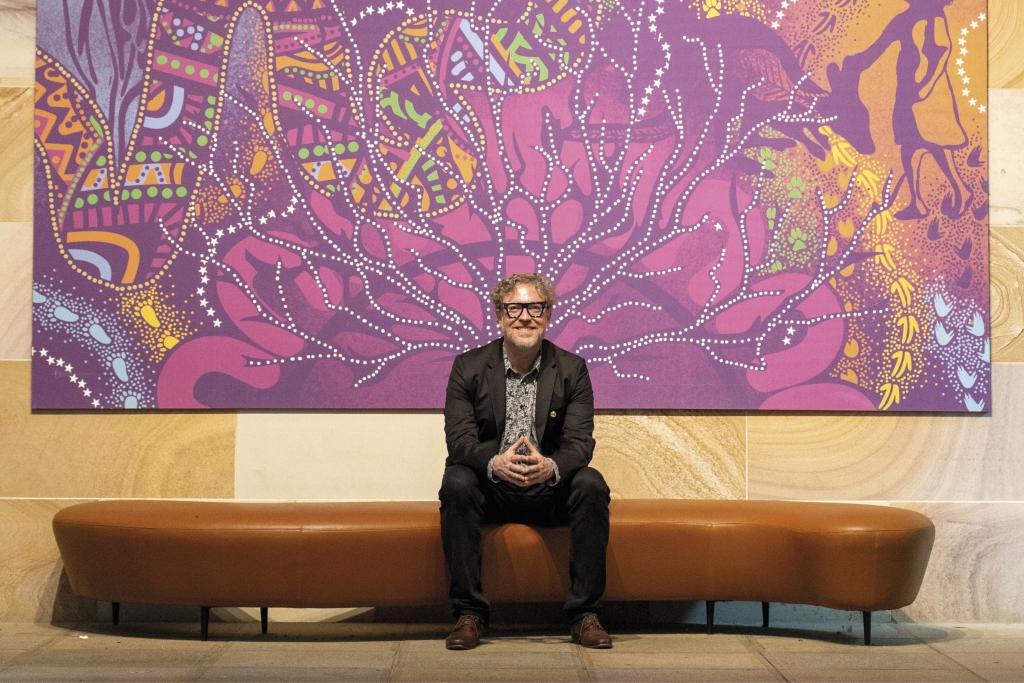
PICTURED: The University of Queensland’s Rotary Peace Centre Director Associate Professor Sebastian Kaempf.
“When we look at our region, the Asia Pacific in particular, we are one of the leading schools in regard to this degree,” says Sebastian.
“We are the first and the oldest school in Australia to offer a degree in peace studies and in conflict resolution. We have some of the world’s leading researchers teaching the fellows and the students in the course itself. It’s an immensely sophisticated, academically rigorous, intellectually challenging program.
“We also bring types of expertise that perhaps other centres might not offer, and that speaks for the diversity of what applicants to the Peace Fellowship program can choose from.
“For instance, Indigenous politics and Indigenous affairs is something we have a lot of expertise in at the school. Not just with regards to Indigenous forms of conflict resolution and mediation as they have existed in Australian cultures, but how they have existed and have been practised and are useful across Indigenous cultures throughout the world.”
Peace, or rather conflict, is certainly centre front of the current world stage. There are more conflicts now than at the height of World War II, and the numbers are rising exponentially.
“We are living in a really terrible period of history,” says Sebastian.
“We had been becoming more peaceful year in year out, from around the mid-1980s until 2013, with the number of conflicts steadily going down and each conflict less violent on average. Right now, starting in 2014, it’s the reverse trend.
The old liberal international order that had existed and provided particular rules with regards to war and conflict resolution… that order is actively being dismantled. And not just dismantled from forces that are illiberal and dictatorship and authoritarian, but also from within.
“We can look at the White House right now, but we can also look at any kind of democratic country, where we see that the forces of ultra nationalism, xenophobia, intolerance are on the rise. And so we see more and more actors actively dismantling and ignoring the rules that we thought, until a few years ago, were set in stone. We see a whole global order shifting, and part of the reason why these conflicts are now popping up is a result of that.”
Sebastian emphasises that we can no longer look at peacebuilding and conflict resolution through the lens that we have in the past.
“We have been thinking about peace, conflict resolution, mediation and peacebuilding in the context of those particular liberal democratic values and rules, the rules that have made up our global order to this day, in particular since the Second World War and then after the dissolution of the Soviet Union from the 1990s onwards.
“Those values are in decline, meaning we are going to find ourselves operating in the context of illiberal societies, authoritarian regimes and dictatorships.
“How do we manage to build peace within this context? That’s something that is really challenging and something we are not really good at thinking through.
“We can’t be stuck in thinking about peace in the old liberal democratic way when this is in decline. And that’s where the Asia Pacific is a really interesting region, because that liberal democratic order has never been fully set up across the Asia Pacific, so a lot of the peacebuilding and conflict resolution that’s been happening here, has already been in that illiberal authoritarian context. In a way, we’ve seen the future already, and I think that’s one of the things where this region can really help in terms of our understanding globally.
“And I think institutions like Rotary, with its big investment in peace, also need to think about what that means for their activities and investments in the future. That’s in a way our big invitation to The Rotary Foundation, and anyone interested, for us to start having a conversation about that.”
Sebastian says we also need to lobby for states to start divesting.
“The investment in peace is being crushed left, right and centre. And it’s not just Donald Trump; it’s Australia, it’s Germany, it’s the European countries, even Sweden.
“The band aid that existed to provide relief for those who are the most vulnerable, that’s gone. But what do states do? They have taken money away from peace and have put it into the procurement of weapons. We’ve got the highest levels of investment in arms that we’ve seen since the Second World War. So that’s a problem.”
It’s a terrible period in history indeed, but it’s not all doom and gloom. There are things that we, as individuals and communities, can do to help swing the pendulum.
“Let’s not believe in what people tell us about war being an inevitable outcome,” Sebastian says. “Wars can always be prevented. There are always non-violent alternatives, and that might sound naive, but I think we’re too much in that mindset where war has become much more accepted.
“One of the principles of the United Nations Charter is the outright ban on the use of violence, with the exception of self-defence or when the United Nations Security Council under Chapter Seven makes the decision that violence can be used to address particular specific threats to international peace and security. These are the only reasons.
“Now, I am not saying that only in the last few years have we seen wars happening despite these international rules that we have given ourselves, but war has become too easily accepted. So, I think we need to shift in mindset back to it being only acceptable under particular circumstances.
“And in a less abstract way, peace is something that is not just about the relations between two big states and their armed forces. Peace is something we can practise in our personal relations with every other human being we encounter. And it starts with respect, it starts with tolerance and it starts with lending an ear to someone and just trying to make that particular space we might be sharing at that particular moment one touch better. And then we can build outwards from there.”
Rotary’s Peace Centres form part of that outward reach, with each curriculum carefully crafted to address specific aspects of the peacebuilding process. More than 1,800 Peace Fellows from more than 140 countries have graduated from a Rotary Peace Centre since the program was created in 2002/03.
“Rotary could not have anticipated the world we’re in in 2026 and how dire it would look when they started the Rotary Peace Fellows program, but it’s been a very smart investment,” says Sebastian. “Because it’s investing in individuals to become future peacebuilders. It’s investing in grassroots and people to go out there and try to make a difference.
“Think of how many Peace Fellows have graduated through this program since its inception. It’s this slow, steady building and education of people who we really can send out into the
field to make the world a bit better and a bit more peaceful.”
WATCH THE FULL INTERVIEW HERE.
- The UQ Rotary Peace Centre will celebrate the 25th anniversary of the Peace Fellowship program on 4-6 March 2027.
- Workshops on the topic of building peace in an illiberal authoritarian context will be held on the Thursday and Friday, with celebrations on the Friday night and the annual peace fellows’ seminar on Saturday. Stay tuned for more details.

Related news
A new lens on refugee self-reliance
Rotary Peace Fellow Miriam Mylvaganam turns research and lived experience into action for displaced people.
Food for Peace: How reducing waste can create a just and sustainable world
Young people are tackling food waste as a matter of sustainability, social justice and global peace.
The power of community: Participating in peace
Rotary Peace Fellows share global field experiences, showing how participation can build peace in communities.