Recouping Rotary’s greatest investment
Rotary International President-elect Yinka Babalola speaks candidly about leadership, personal transformation and why reconnecting youth pathways is essential to securing Rotary’s future.
PHOTOS @rhysmartinphotographer
During the 2025 Rotary South Pacific Conference, 31 October – 2 November, RDU had the opportunity to chat with RI President-elect Yinka Babalola. We didn’t get quite as long with him as originally planned because, ironically, he was delayed almost a day after being told he needed a certified polio vaccination to enter the country!
Regardless, we covered quite a bit of ground. In this wide-ranging Q&A, Yinka reflects on leadership, personal transformation and Rotary’s responsibility to nurture its greatest investment – young people – challenging every Rotarian to do better than their best and to reconnect with the lasting change Rotary creates within us all.
Yesterday, you asked every Rotarian to look back on the past seven years, choose their best one, and do better than their best. What was your best year and what would you do better?
As club and district leaders there are expectations of leadership, particularly as we deliver on our Vision Statement, on our Action Plan. What I’m asking Rotarians to do, whether you’re a club leader or a district leader, as part of your leadership do something better than your best.
Not as individuals, that would mean something different.
So, if you look at the last seven years and you find that as an individual Rotarian for example, you tell yourself, hey, my best hours of participation at Rotary were X number of hours. I’m saying make a plan to do a little bit better going forward. Because for the club to perform better, individual Rotarians must perform better. And that simply will mean sometimes that when the club leadership calls on you, you say yes.
So maybe from an individual point of view, you tell yourself, wait a minute, I’ve said no to Rotary many times. I want to say less no going forward. And that will be better than yourself.
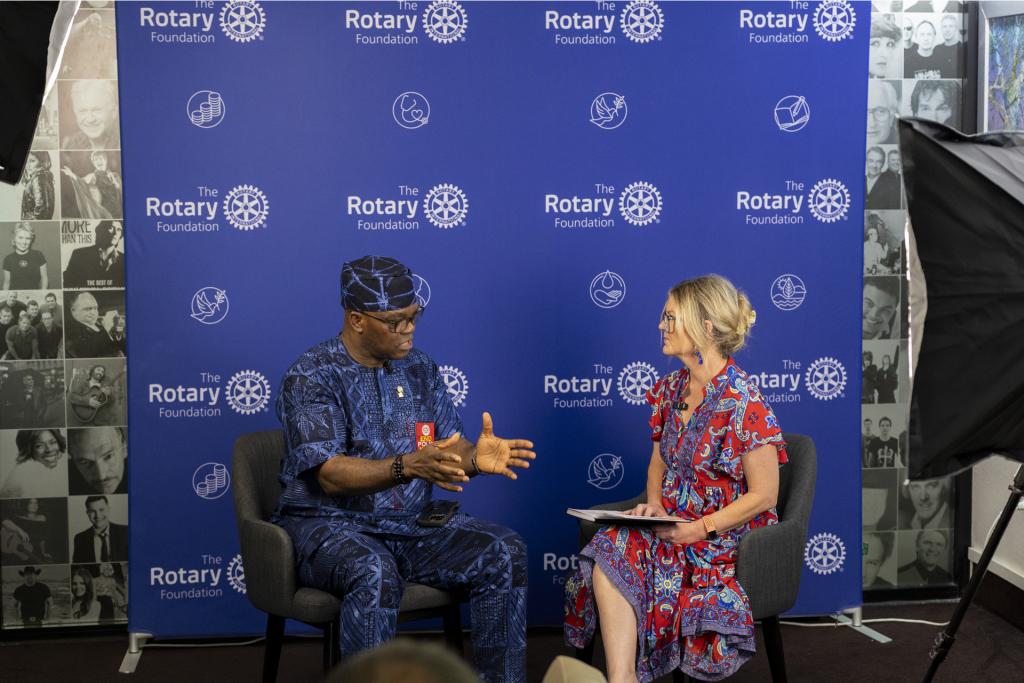
You also asked Rotarians to look at themselves and ask how Rotary has made a lasting change within themselves. How has Rotary made a lasting change within you?
A lot! Rotary has grounded me. I had a relatively privileged upbringing. In fact, I used to tell people that were it not for Rotary I’d be floating in the air. Just floating. Rotary grounded me.
Rotary allowed me to see more and to connect more with my community.
Rotary had a great impact on my career also.
And, you know, I was also a Rotaractor. The opportunity that Rotary gave me as a young person to interact with people and to get mentored by people in my vocation, in my profession, in the same industry as me, made a lot of difference.
I do tell people sometimes that, when I was 28, I’d been a Rotarian by then, that the kind of things that were occupying my mind, weren’t the kind of things that would occupy the mind of a typical 28-year-old. Just because I had Rotary.
So, yes, it made a lot of difference.
You mentioned Rotaract. I believe you are the first Rotary International president who is a past Rotaractor? How do you think we engage more Rotaractors to make the transition into Rotary?
Yes, let me give you my thoughts on that from a systems point of view. I like telling stories, so I hope I don’t bore you.
Many years back, I think it was in Charles de Gaulle airport in Paris. I was on one of those escalators as you go up into the departures, and I had my Rotary pin on. A gentleman was by my side and as we came off the escalator, he turned to me and said, ‘You are a Rotarian’.
And then he said something that has kept me thinking since then. He said, ‘You know, you guys are the only group of business and professional people known to me who don’t care about their investment’.
He worked for one of the agencies, I think it was UNICEF or WHO, and the example he gave was, ‘You guys give us money to use locally, internationally, so Rotary International will do things with UNICEF and the rest. You have given us, say, in Congo, US$25 million to do work on polio. You have Rotarians in Congo, this is your project, and you never actually stop to say, hey guys, what are you doing?’
He expected that is what businesspeople would do. And so we’re not, we never cared about our investment.
And I’m converting that to Rotaract. I also feel that we’ve invested a lot in our youth and we have not made any conscious engagement efforts to recoup our investments.
We spend a lot of time, resources, on Interact and then we never cared to ask, ‘When these Interactors leave school, what’s next for them?’
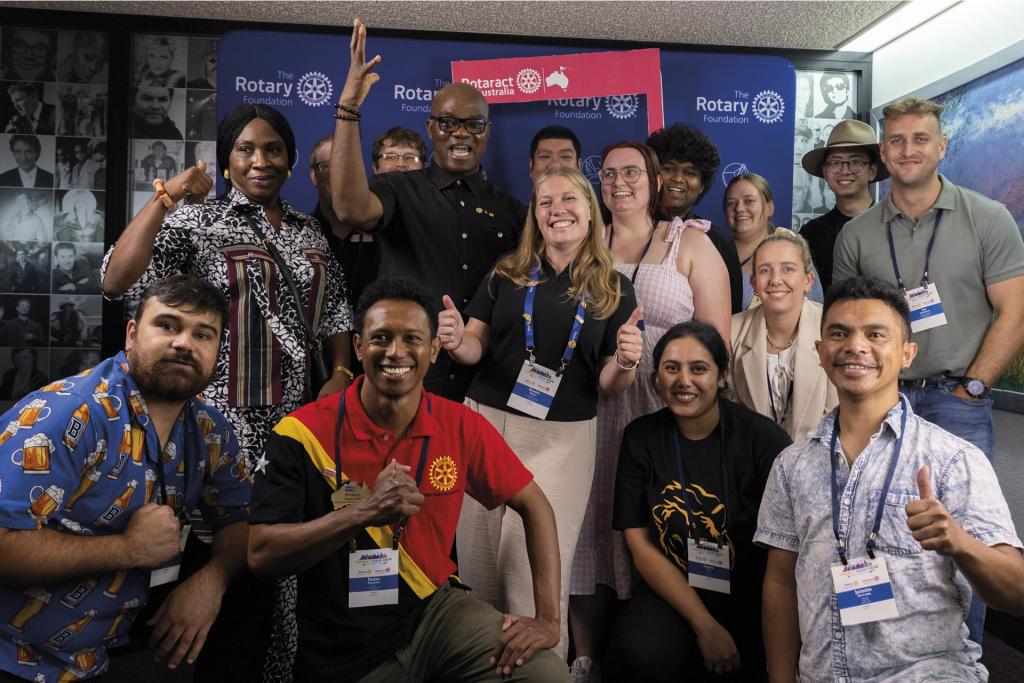
Ordinarily, you would expect that when they go to college there would be a Rotaract club waiting for them. If they go to RYLA, who asks the question as they leave, what next?’
If RYLA is for people of Rotaract age, for example, do we make a conscious effort at this RYLA camp to introduce them to Rotaract?
We have Rotaractors and we can tell them to look out for former Interactors fresh into college and say, ‘Hey guys, you’re at such and such college with the Rotaract Club of X, Y, Z, we have information for you.’
And the analogy I give is about soccer. I know in Australia, of course you play soccer, you play football, but I know you like rugby more.
What I say is, if you look at those big football organisations, they all have junior academies. They train them, they put them in a camp, they coach them, they mentor them, and there is somebody watching them who decides at a point that, ‘Hey, you. You are ready to play for the senior team’.
You see, all the time those children are in training, in their camp, in the academy, it’s all investment, investment, investment. And at that point there is no income, no revenue, no recoup of investment by the team. But at that moment when a manager says, you are now ready to play for the senior team, they start to recoup their investment. And if the senior team happens to be such that they have so many people from the junior team that they cannot take in the senior team, the manager decides, ‘We don’t have space for you, but we think another football club may need you’. And we will sell them. So, they recoup their investment.
And I’m asking, for us at Rotary, where’s our manager? We’ve looking at other investments we’ve made; do the Rotary clubs or even the Rotary districts have any data of where their Interactors are?
I was in Albuquerque, New Mexico and, in a conversation like this, a governor-elect said, ‘Look, in my district we have 4,000 Interactors. And ordinarily that would mean we have close to 8,000 parents. But we have 1,200 Rotarians.’
You get what I mean? If you talk to those parents the response you would get is, ‘Nobody has asked me. I don’t even know how to join.’ They don’t know how to join.
So, that is the sad part of it for me. And let me say this. As a product of Rotaract myself, many of us joined Rotaract not because Rotary looked for us and said, ‘Hey, it’s time to come home’. Many of us stumbled into Rotary. It shouldn’t be so.
And so is youth going to be one of your key focuses during your presidential year?
I am conversing for that.
There are many parts of our Rotary world where they don’t even have a Rotaract presence. So, in their own case they need to invest. And the data shows that every single part of the Rotary world that is thriving and growing today has a thriving Rotaract program. Youth membership, you know.
So, we invest in Youth Exchange. All those people we’ve sent on Youth Exchange, where are they? Has anybody reached out to them? Usually, no. One of our current directors told me she was on Youth Exchange about 30 or 35 years ago. She worked for Microsoft in the US and then she retired, and in retirement she stumbled across Rotary. Somebody asked her, ‘Have you heard about Rotary?’ And she said, ‘Oh, yes, yes. I was a Rotary Youth Exchange student.’ They said, ‘Well, would you like to join Rotary?’ Of course, her answer was, ‘Yes’.
How come, for 35 years, despite a very successful career, nobody, nobody asked her to join Rotary. And we are having the same thing everywhere.
I’ll tell you this for free; I suspect, I don’t know, but I suspect that even what we call Rotex – the Rotary Youth Exchange group – they have probably formed that group because Rotary didn’t provide them an alternative. So, they formed their own.
And that is what I mean by recouping our investments. We need to do that. I think it is a sure path to Rotary’s future. I’m convinced. I’ve met past Rotaractors, and because they already know about Rotary they don’t need any convincing. They just fit in and do what they need to do.
So, basically, I’m looking at where is that system that links Interact, Rotaract, RYLA, Youth Exchange? These are the areas where Rotary invests in youth. I know of no other organisation that spends so much on youth and yet has a shortage of young people.
There must be something we are doing wrong. And I’m asking Rotary leaders to look into it. Don’t wait for an intervention from Evanston, it won’t happen. But locally, do something. It’s your own investment. Recoup it.
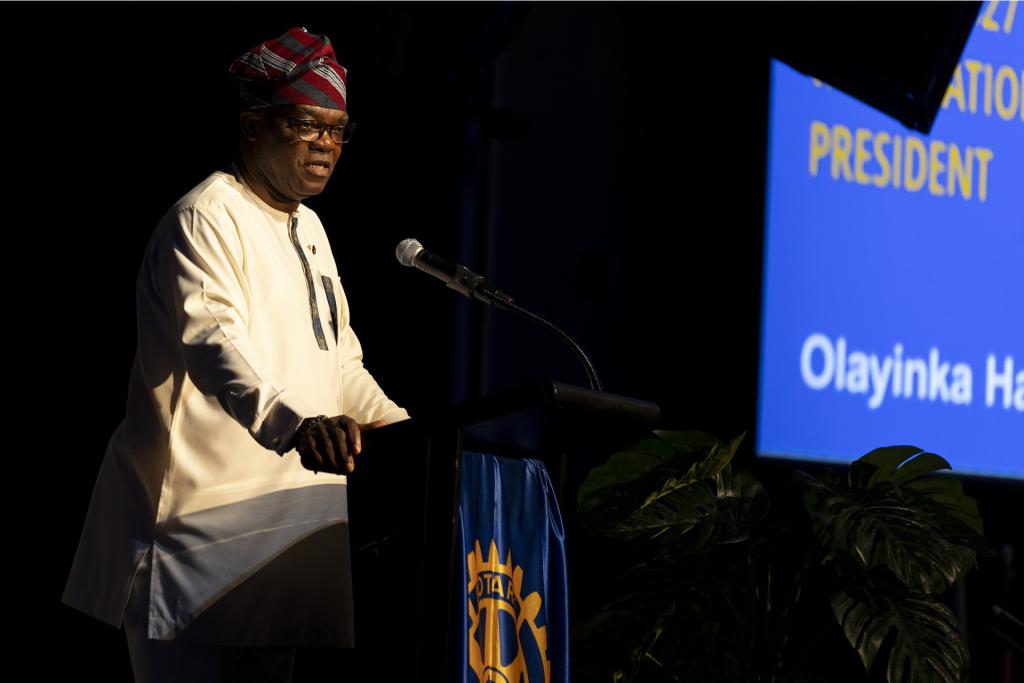
Apart from youth, are there other areas you plan to focus on during your year as president?
There will be, but I will leave that until after the International Assembly. But my main message is simple; Rotary means different things to all of us. But one thing is common to every passionate Rotarian I have met, and that is that Rotary has changed many of us.
One of the things I would like to see over the next year is for Rotarians to talk more about how Rotary has impacted them. You see, when we talk about lasting change, we usually talk about it from the point of view of those who benefit from the things we do. We talk about lasting change in our communities, we talk about lasting change in the people who benefit from our services. But we also know that it’s lasting change in ourselves, and I want Rotarians to talk more about that.
I want to attempt to restore the emotional connection between Rotary and Rotarians. Because otherwise, if it was just about service projects, why are we not like Red Cross? If I want to help pack food, I can go to a group that’s packing food and help them on the weekend. And I don’t have to pay to do that. But you ask people to come to Rotary and pay. What they are paying for is not the service that we render, what they are paying for is that lasting change in themselves. That’s the opportunity Rotary has given them, which many other organisations don’t provide in this structured manner.
Again, if you look at today, those three young people that were part of that panel, look at what they talked about; how Rotary has impacted them, even at this young age. If you asked any of those three young people, ‘What is your experience so far? Would it be ok if you hadn’t experienced it, if you had deferred it 15 years from now?’ I’m sure they would say, ‘No,no,no, I wouldn’t want to wait 15 years to experience what I’ve experienced.’ Lasting change.
But I think if we talk more about it, how Rotary has impacted us, in all our conversations, and I understand that many of these stories are personal. They’re very personal stories and we sometimes feel vulnerable expressing those personal stories, but that’s what we need to do.
Because when you tell people you have an opportunity to make a lasting change in yourself, the answer will most likely be, ‘Yes’. And then, ‘Tell me how?’
Has there been a project you’ve heard about during the conference that you found particularly inspiring?
Many of them. For example, the Falls Prevention project.
I have a background in health and safety, and at a point in my career my duty was to make sure people didn’t fall from heights. But you see people falling, tripping typically, and it’s something you don’t think a lot about.
I found that project very interesting. You see, if you look here, on my leg, there’s a cut. I had a fall about 20 years ago and I fractured my ankle in six places. It took a surgical operation to put my ankle back together. I was listening to the presentation, and I thought, wow, why haven’t I thought about that. How can we help?
The second one for me is the one on snakebites in PNG. There is a part of Nigeria that has a similar problem. I have visited the place. I have seen what the Rotary club has tried to do to help. But for somebody who is into systems, when I looked at what they are doing I couldn’t find a system behind it. I tried to ask them a few things and to see how Rotary can help, how I as a Rotary leader can help. I was trying to see what system we could put around it that will make sure this thing is sustainable. I didn’t get the answers.
I had a few ideas of things to pitch together, but the minute I saw the presentation today, I said to myself, this is what we need for Kaltungo. And if you Google Kaltungo, the first thing you will see about Kaltungo is snakes and snakebites. Rotary wants to help. The Rotary club in the city wants to help. They are helping, but I think there is much more we can do, similar to what has been done in PNG.



Related news
Rotary opens eighth Peace Centre in India
Rotary opens its eighth Peace Centre in Pune, training leaders to build understanding and resolve conflict.
Rotary Peace Fellow leads education in emergencies across the Middle East
Rotary Peace Fellow Lucienne Heyworth uses education to restore hope in communities affected by conflict.
A new hub for peace and development in Asia
Rotary opens applications for its newest Peace Centre at Symbiosis International University in India.