Survival, service and finding solutions
PICTURED: 2025 recipient of Rotary International’s Award for Excellence in Service to Humanity, Roanne Monte, has led a vibrant life, taking her from the stages of London’s West End to the development of ground breaking personal safety technology.
Roanne Monte’s transformation from a harrowing stalking experience to life-saving personal security technology earned her the 2025 Rotary Award for Excellence in Service to Humanity. Here, she opens up about her dynamic life, and the victories that can come from finding strength and empathy through hardship.
Words: Sarah Atkins. President, No Borders Rotaract.
Being stalked presents an amount of physical risk, but it’s the psychological element that quickly becomes overwhelming. Even if no contact between stalker and victim occurs, the constant looking over your shoulder is debilitating and consuming. It isolates you, making it difficult to explain yourself to those around you, let alone authorities. Compiling evidence can feel insurmountable.
This was the uphill battle faced by Roanne Monte, now the CEO of Armatec Global. After her personal experience with a stalker, Roanne decided to put her decades of coding expertise to work, developing AI risk intelligence platforms to help others going through similar experiences. The result was Ro&® – a service made for the everyday person, using artificial intelligence to help them sift through whatever evidence they can find, compiling experience reports and finding connections across events. For someone tormented by the mental effects of stalking – which can feel like carrying a full cup of water with shaking hands – this technology is groundbreaking.
Roanne is a charismatic leader who is whip smart when it comes to tech. Genuine selflessness is not the first term that comes to mind when one thinks of tech CEOs, but even atop an extremely successful platform, she is genuine, soft-spoken and happy to help.
“We’re a lot stronger than we think we are,” she says. “When I share my story with people, I remind them we all have a lot more strength within ourselves than we realise.”
Roanne’s life has been vibrant, but not always easy.
“It was a tough beginning in the Philippines. I had a very turbulent childhood. On its face, it’s terrible to grow up in a turbulent household and go through what we would immediately believe to be negative experiences.” But she is quick to underline that those experiences led to strength and empathy.
“Australia was like a saving grace for me, because it was a different life.”
Roanne still identifies as Australian. Even though her journey has taken her from musical theatre stages in London to Singapore to high-rise offices in Chicago and New York, her roots are here. She speaks with particular gratitude for her maths teacher, Mr Francuz, who continued to tutor her when she was pulled away from school in Australia, waiting on immigration papers.
“It was very strict back then. He was upset that I was taken out. While he was grading papers, he would give me math problems and would teach me. I wouldn’t be where I am today without these mentors.”
Her mother, too, pushed her to build self-confidence by singing in open markets.
“She would put me up on a market table… tell all her friends that I’m gonna be singing and busk with an open guitar. Me, an eight-year-old, thinking I’m Whitney Houston. Singing these love songs,” she laughs. “It blossomed into this kind of performing arts piece that I never thought I would get into, because I’m fundamentally shy.”
Eventually, Roanne would end up headliningMiss Saigon in London’s West End.
“But the science and tech was always there. I started coding when I was eight, even though [they would say] this is not what girls do.”
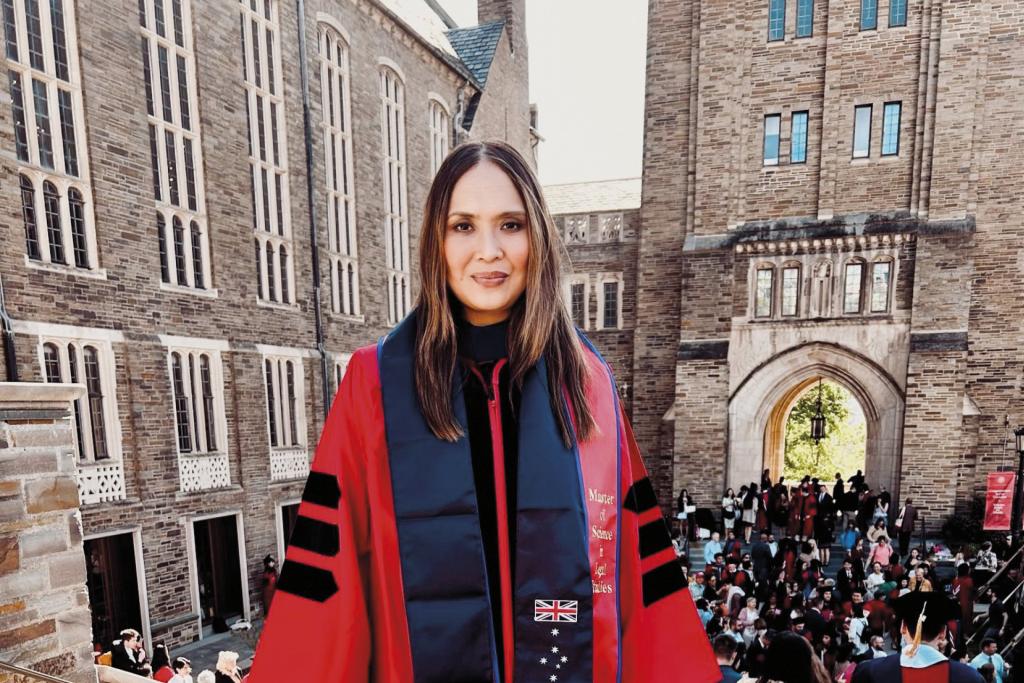
PICTURED: Roanne graduated cum laude at Harvard University, studying computer science with a minor in psychology, and went on to do a Master’s Degree in law at Cornell University in New York.
Roanne’s stage-seasoned confidence, combined with her prodigious skills in STEM, would lead her to Harvard, where she graduated cum laude, going on to do a masters’ at Cornell University in New York. Her field was primarily in computer science, but she chose to minor in psychology. Part of this, she says soberly, was from a desire to understand the actions of those who had made growing up in the Philippines difficult for her.
“I really believe in psychology. I really wanted to understand why certain people, family members, behave a certain way.”
When the stalking incident occurred, after she had returned to Lavender Bay, NSW, her studies in psych served her once again.
“It was just after the borders closed,” she says, referring to the pandemic. “I was stalked by a security officer, whose workplace was opposite where I was living. It was probably one of the lowest points in my life because it went on for over a year. I felt very gaslit.
“I told the business what was going on. They didn’t really do anything about it. And then, with the police, there was a lack of evidence because they needed proof and, you know, are you imagining things? Is your life in danger?”
Instead of breaking down, Roanne harnessed the strength needed to develop her own software to deal with the problem. It was an incredibly difficult thing to do.
“I had experience with platforms and systems. I thought, there has to be other people who have gone through this. But the average person doesn’t have technology knowledge – they wouldn’t know where to start. The immediate thing is fear.”
Version one of the Ro&® security technology was released to the public in March 2025. Unlike other physical risk intelligence platforms, Ro&® is AI-native from the ground up, meaning it has a user-friendly way to comb through extensive amounts of material to look for specific requests, creating custom case reports. Users can tailor requests at every stage of the process; the AI is solely within the analytical and diagnostic realm, and does not draw its own conclusions.
“It’s upload, analyse and report,” Roanne explains. “Three steps. It gives the power back to the person using it. Instead of being flooded with video footage, they can, with quite pinpoint accuracy, find those relevant incidents.”
She asserts that while AI can never replace humans, it could still overwhelm us if we don’t use it responsibly.
“The more that AI systems are built by well-intended people, the better it is. So I feel like, for the ecosystem, society should focus on people who are prioritising the good and encourage more young people to build and learn.”
Rotary’s Excellence in Service to Humanity award is reserved for non-Rotarians who exemplify Rotary’s ideals, such as selflessness, leadership and commitment to service. Roanne’s immediate response to her ordeal was to try and help others.
“Roanne’s life is a testament to courage, creativity and unwavering commitment to others,” says Past District Governor Tonia Barnes. “Her work exemplifies the spirit of this award.”
“Serving has always been in my history,” says Roanne. “I was a connect group leader for my church, helping youths in New York. So I was happy that I didn’t build a platform that’s just for tech’s sake. I’m not going to build a platform just for money. That’s not really what drives me. But this was a strong enough purpose. As I’ve done in my past when there’s something very, very negative, I wanted to turn it into something positive.”


Related news
Reviving Rotary in Yamba
Yamba Rotary’s focus on visible, cause-driven service is inspiring new members and renewed community support.
Lions and Rotary unite to help end polio
Stanthorpe Rotary and Lions unite to honour service leaders and raise funds to help end polio worldwide.
Rebuilding futures, one tractor at a time
Rotary’s Restore Me program rebuilds tractors while helping students gain skills, confidence and jobs.