Driving Change
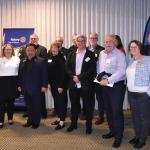
PICTURED: Retired police officer Kim Smith has transformed driver education for Tasmanians with limited English skills.
Sullivan’s Cove Rotarian Kim Smith, a retired police officer turned learner-licence tutor, has transformed driver education for Tasmanians with language, literacy and learning barriers through an innovative, Rotary-supported blend of visual, kinesthetic and video-based training.
WORDS Sarah Atkins. President, No Borders Rotaract.
Kim Smith is a retired police officer, and as such, knows the importance of road safety first-hand. This led to a considerable amount of stress when he became a learner’s licence tutor confronted with the problem of how to teach road rules to groups with English limitations, or who are linguistically diverse.
“I was literally tearing my hair out,” he says. “There was a huge variance of limited English skills among the group, and I was finding it so difficult to teach them under the circumstances. I drew diagrams on the whiteboard, but I could sense they needed a better way to receive the message.”
After a troubled night, Kim woke at 4am with an idea and leapt out of bed to scrawl it on a notepad in the dark. The next day, he turned up armed with toy cars, large road maps and rolls and rolls of butcher’s paper.
I rolled out lengths of paper across the floor depicting intersections, junctions and roundabouts. I had them walk on the butcher’s paper as if they were driving to physically illustrate who gives way to who. They were given homework to spend time watching from the footpath. Because of their limited English, I found that the visual and kinesthetic way of training worked better than the auditory or written methods.”
This is where Rotary comes in. A year later, Kim had redeveloped the diagrams into laminated A3 sized sheets, but still felt something was lacking. He wanted to give his students a sense of actually being in a car. As an experiment, he asked his wife and brothers-in-law to film him driving and the view from the car window as he navigated the road. The positive effect on his students’ lessons was immediate.
“I can remember one of the interpreters saying how much it made his explanations so much easier. We could see improvements straight away.”
Kim later met with personnel from the Department of State Growth to see how these videos could be formalised and professionally produced. Martin Crane, the Registrar of Motor Vehicles, agreed they were a valuable resource, and could be expanded to also target audiences with learning disabilities or developmental issues.
Transport Minister Matthew Groom requested that it be replicated statewide. And so, with financial support from The Rotary Foundation and the Rotary Club of Sullivans Cove, Tas, as well as West Moonah Community House, Neighbourhood Houses Tasmania, and State Growth Funding, the professional filming took place. Kim then found he had a lot more work to do.
As the producer of the videos, it was essential to train other Learner Licence Assistance Programs (LLAP’s).”
Kim travelled around the state to libraries, neighbourhood houses and welfare agencies, assisting in training the other teachers to effectively utilise this style of learning. This first tour brought him into contact with another LLAP tutor, Ross Warren, who had encountered the same issue and devised his own maps. The two men worked together to combine their ideas and create a polished final product. A district grant came through with enough funding to ensure every state library, neighbourhood house and LLAP agency was able to receive printed copies of the road maps.
Roslyn Teirney, the grants chair for District 9830, called The Rotary Foundation’s role “heroic” in helping Kim and the Sullivan’s Cove club get the maps out across the state. USB sticks, meanwhile, were provided by the government so that the videos could be shared alongside the maps.
The videos and road map packs have made a huge difference in the training and testing process,” Kim says. “The scope widened further afield and grew to address a whole range of Tasmanians with significant literacy and learning spectrum issues such as ADHD, autism and dyslexia.”
Grateful students have left lengthy, enthusiastic reviews of Kim’s training materials. One refugee emphasises the positive outcome this has made on their entire situation.
I achieved a licence and started paying for my own house. I learned so much with the video footage, because it’s easy to understand in our language.”
Two local youths, meanwhile, had struggled with the test over and over – one 16 times and the other over six months – before Kim’s training.
“They passed with flying colours,” he says happily.
Thanking Kim enthusiastically after her test, the youngest girl emphasised how important the material had been. “The videos were amazingly helpful. I would never have been able to pass the test without watching them.”
Kim continues travelling around the state providing ongoing training. For him, it’s a simple matter of empowering people to gain the independence and skills they need to get behind the wheel; something that can transform their whole lives.
“Witnessing the absolute joy – tears of joy in a number of cases – when they receive their certificate are positive memories that will stay with me for the rest of my life.”