Riding with purpose
PICTURED: Brisbane rider Jim Xinos and his Triumph.
Rotary backs Bloodbikes Australia to deliver better health outcomes across the country.
When every conventional option has been exhausted and something critical still needs to move, a quiet group of volunteers stands ready. Bloodbikes Australia is providing a last-resort transport service for blood and medical supplies, free of charge, ensuring healthcare providers can focus precious resources where they matter most.
Founded just over six years ago, Bloodbikes Australia has grown from a small Brisbane-based initiative into a nationwide network of more than 400 qualified volunteer motorcyclists. Collectively, they offer a unique service: the safe, compliant transport of essential medical items when commercial couriers, taxis or internal hospital options are unavailable or impractical.
The idea was sparked overseas. Founder Peter Davis, a Rotarian, was inspired by the long-established Bloodbikes movement in the UK and Ireland.
“I had a mate volunteering for Bloodbikes Scotland and thought, what a great idea,” Peter says. “It was a chance to do what I love – riding motorcycles – and do good at the same time.”
Back home, Peter approached Mater Pathology in Brisbane with a simple proposition: volunteer riders could assist with the transport of blood, initially as a trial. With nine volunteers, the service expanded quickly to include pathology, medicines and equipment. Word soon spread. Today, Bloodbikes Australia volunteers operate in every state and territory, supporting 76 healthcare providers from Cairns to Hobart, Perth to Sydney.
Since commencing operations on 21 September 2019, volunteers have completed more than 11,000 pick-ups and deliveries, travelling in excess of one million kilometres.
Their cargo can include blood, biopsies, COVID tests, clinical trial samples, corneas for transplant, bone tissue, stem cells, breast milk, equipment, paperwork and even personal items left behind by patients on discharge. In remote regions, volunteers also transport medicines and equipment to aircraft bound for communities further afield and deliver supplies to patients managing treatment in their own homes.
Bloodbikes Australia operates on a clear and disciplined framework. Volunteers are independent, but work under an agreed set of rules that form their collective commitment to one another and to the healthcare providers they support. Every rider holds a nationally recognised Certificate in Blood Transport. Importantly, as Peter emphasises, “We are not emergency vehicles. We are not ‘wannabe’ police or ambulance. We obey all road rules.”
Equally critical is the organisation’s positioning as a last-resort service.
“We do not want to interfere with commercial arrangements or anyone’s employment,” Peter explains. “But when all other options are exhausted, we are available.”
It is this clarity that has earned trust across the health sector, with hospitals and institutions including Gold Coast University Hospital, Royal North Shore, Melbourne Eye and Ear Hospital, St Vincent’s Sydney, Werribee Mercy Hospital and St John of God Perth among those supported.
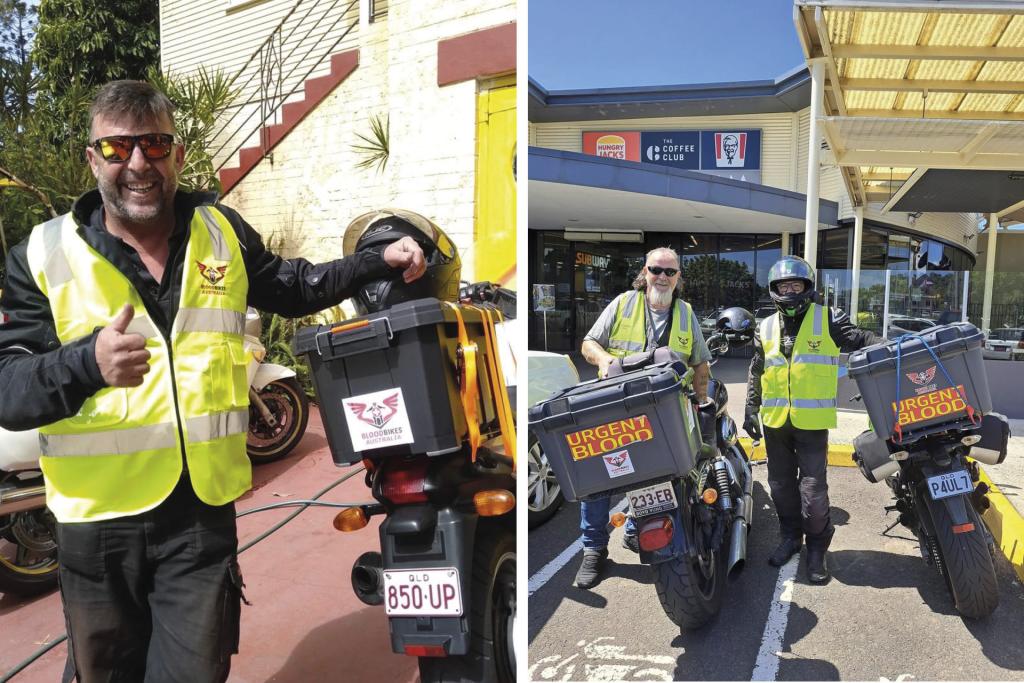
PICTURED: Bloodbikes volunteer Lucky Phil Picking up blood from Laidley hospital to deliver to Esk and Ipswich, Qld.
Rotary joins the cause
What makes this story even more remarkable is that Bloodbikes Australia has operated without a formal funding structure. Volunteers donate their time, motorcycles, fuel and tolls. This gap is where Rotary has stepped in.
Recognising both the impact and the vulnerability of such a model, Rotary District 9620 approached Bloodbikes Australia to explore how support could be provided without compromising its independence. The solution was practical and aligned with Rotary’s values: prepaid fuel cards for volunteers while they are on duty.
Under this arrangement, riders begin a job with a full tank and use the fuel card to top up once the delivery is completed. All trips are logged, with distances and fuel use recorded, ensuring transparency and accountability.
The Rotary Club of Greater Springfield, Qld, has taken the lead, establishing what is hoped will become a national Rotary project. Managed by the Greater Springfield club, the project provides a channel for donations and the coordinated distribution of fuel cards, directly supporting Bloodbikes Australia volunteers and, by extension, the patients who rely on timely delivery of medical supplies.
Past District Governor Paul Roger, who is managing the Rotary fundraising side of the project, recalls his first encounter with the initiative.
“When I became aware of Bloodbikes Australia at District Conference, I was amazed they were delivering this level of community service without any funding,” he says. “It seemed a no-brainer for Rotary to assist and help ensure the sustainability and future growth of their service.”
Paul notes that the project is now well positioned as an ongoing impact initiative that any Rotary club can support and actively promote.
“The Bloodbike volunteers also make excellent speakers for club meetings and conferences,” he adds, bringing the story of service vividly to life.
By working together – Rotary, healthcare providers, volunteers, individuals and businesses – this growing service can be sustained and expanded. It is a powerful example of Rotary’s ability to identify need, partner wisely and deliver practical solutions that create lasting benefit for communities across Australia.
For more information on Bloodbikes Australia, visit bloodbikesaustralia.com.au, follow them on Facebook or contact PDG Paul Roger via greaterspringfieldrotary@gmail.com
If your Rotary club would like to contribute to the project you can click here to donate.


Related news
Rotary’s quiet revolution in mental health and crisis support
A simple QR code connects people with trusted mental health and crisis support at any hour, without judgement.
Bangers to Bluff celebrates 10 years of adventure
Bangers to Bluff marks 10 years, with 17 teams driving New Zealand and raising more than $100,000 for charity.
Rotary gala raises $35,000 for brain cancer research
Hunters Hill raised $35,000 for brain cancer research at a gala celebrating hope and community.