Membership follows purpose
PICTURED: Hundreds of Mackay community members, including around 1,000 students, marched through the Mackay CBD on 30 May in a united stand against domestic and family violence, with leaders encouraging the next generation to help drive lasting change. (Photo: Hannah McNamara)
By shifting its focus from recruiting members to creating meaningful community impact, the Rotary Club of Mackay, Qld, revitalised its membership through a powerful domestic and family violence prevention program.
Words Michael Buckeridge. District Membership Chair.
Photos Life Publishing Group.
Five years ago, I found myself staring at alarming Rotary membership statistics. Across almost every district in Zone 8, clubs had lost around 20 per cent of their members over the previous five years. Clubs were still recruiting, but around half of those new members were leaving within three years.
At the Rotary Club of Mackay, Qld, those figures felt personal. As we approached our 100th anniversary, membership was declining, energy was fading and our future felt uncertain. It became obvious that doing more of the same thing would not produce different results.
The first lesson was simple: membership is not a project. It is the result of everything a club does.
People remain in Rotary when they experience meaningful service, genuine friendships, opportunities to grow and, above all, enjoyment. If we wanted stronger membership, we first needed a stronger club.
We also recognised that different generations wanted different Rotary experiences. Our long-serving members valued the traditional model, while many prospective younger members wanted greater flexibility. Rather than forcing everyone into one structure, we established a companion satellite club as a sub-committee of our existing club. It offered a flexible pathway without the administrative burden of forming a separate club and quickly attracted eight new members.
We introduced orientation sessions, involved partners and families as honorary members, and focused on making meetings and projects more enjoyable. These changes helped, but we still lacked something capable of uniting the club and energising the wider community: a signature project.
The turning point came through Past District Governor Dave Harmon, whose club had achieved remarkable growth through a domestic and family violence prevention program. Dave and Robbie generously shared what they had learned, giving us a practical model to adapt.
Soon afterwards, at a thank you function hosted by a local homeless shelter, I spoke with representatives from BHP. When asked what projects Rotary is working on, I boldly said: “We’re planning a major Domestic and Family Violence Prevention Program across the Mackay region.
We’re going to distribute hundreds of purple shirts through our high schools and involve the entire community.”
At that point, the project existed only as an idea.
The next day, BHP called: “We’ll buy the shirts.”
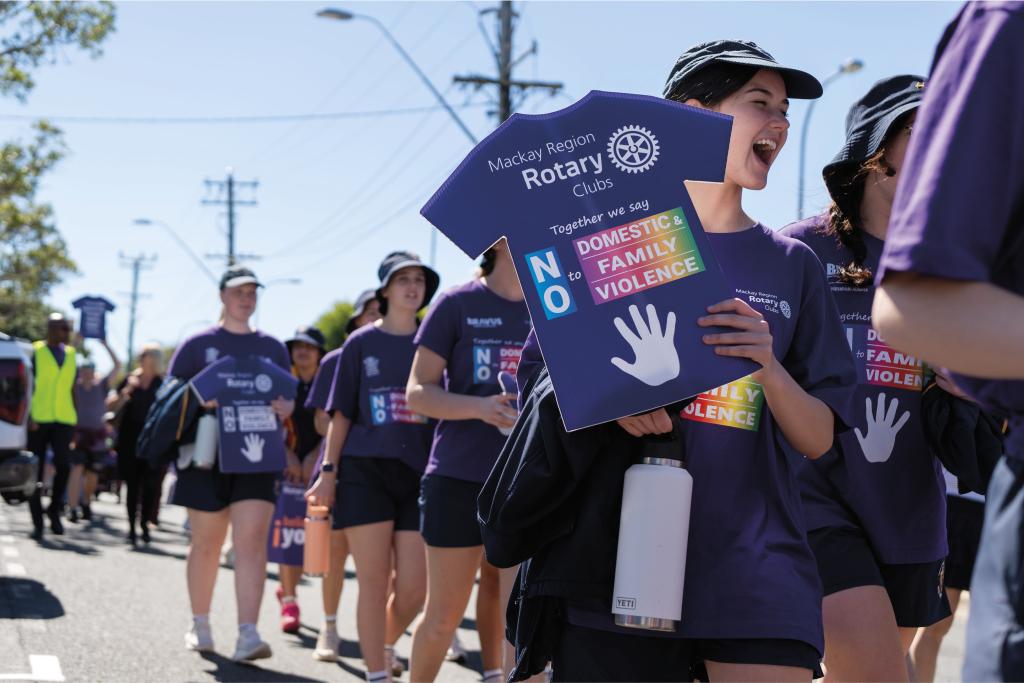
PICTURED: The Rotary Clubs of Mackay’s Respect in Every Step march aimed to empower students and the wider community to denounce and report Domestic and Family Violence.
That conversation changed everything. We realised people do not fund Rotary because Rotary needs money. They support projects because they believe in solving important community problems. Instead of asking how we could grow membership, we began asking how we could build something so valuable that people would want to be part of it.
Businesses, government agencies and community organisations joined us, many contributing around $10,000 in funding or in-kind support. By the second year, the program was valued at more than $110,000 without using club project funds.
Artificial intelligence became an important tool in preparing grant applications. The ideas, facts and objectives remained ours, but AI helped organise them into clear, professional submissions tailored to each funder’s priorities. We also used GrantGuru to identify opportunities early, turning grant writing into one of the club’s highest-value activities.
Partnerships were equally important. When we decided to bring the R4Respect education team to Mackay, we needed accommodation for six presenters and their manager for almost a week. Mainstay Suites provided almost $8,000 worth of accommodation, while the Queensland Domestic and Family Violence Prevention Council brought evidence-based programs, specialist presenters, researchers and people with lived experience. Rotary contributed volunteers, fundraising, event organisation and local relationships.
The program increasingly focused on prevention. On expert advice, we shifted school education from senior students to Years 7 and 8, reaching young people before unhealthy attitudes became entrenched. Purple Fridays encouraged schools, businesses and residents to wear purple throughout May, turning thousands of shirts into walking billboards for respectful relationships.
Student leaders were equipped to become ambassadors among their peers, while the most visible event was the Respect in Every Step March through the streets of Mackay. Police readily supported it, explaining that domestic and family violence accounted for around 60 per cent of their operational workload.
On the day, more than 1,500 students, teachers, business people, community groups, government representatives, families and Rotarians filled the streets, chanting: “What do we want? Respect! When do we want it? Now!”
The results extended far beyond awareness. Schools began developing their own respectful relationships programs. Mackay Women’s Services reported an increase in people seeking help, suggesting more victims felt able to speak up. The club attracted more than $110,000 in support and welcomed 13 new members in one year – people drawn not by a membership campaign, but by the opportunity to contribute to something meaningful.
Looking back, this was never really a membership project. Membership growth was the outcome of building something the community valued.
When Rotary tackles important issues professionally, businesses want to partner, governments want to support, volunteers want to help and new members want to join.
Strong clubs are built by giving people opportunities to make a genuine difference.
Five years ago, I worried about whether our club would still be thriving at its centenary. Today, it has renewed energy, growing membership, stronger partnerships and a project creating measurable community impact.
If Rotary wants to grow, perhaps the first question should not be, “How do we get more members?” It should be, “How can we make a bigger difference?” The members will come.
The DFV Tool Kit for cause-based club transformation has been updated (2026). Download the latest version to learn how your club or district can get involved in the advocacy and education campaign: bit.ly/dfvtoolkit


Related news
Saving Private Kununurra
Rotary lives on in Kununurra through a flexible e-club model keeping local service and connection strong.
Rotary’s quiet revolution in mental health and crisis support
A simple QR code connects people with trusted mental health and crisis support at any hour, without judgement.
Our starfish: Relief for Queensland family
Rotary rallied around young Cade, raising $35,283 to support his recovery, treatment and growing independence.