From Tasmania to the world
The Food Plant Solutions Rotary Action Group and the Food and Agriculture Organisation of the United Nations unite to highlight local food solutions as a practical response to a global challenge.
As the world faces intersecting challenges of hunger, malnutrition, climate change and rising food costs, practical and scalable solutions are urgently needed.
At a recent FAO–Rotary seminar in Cairo, Egypt, senior leadership from the Food and Agriculture Organisation of the United Nations (FAO) highlighted the work of the Food Plant Solutions Rotary Action Group (FPSRAG) during discussions on nutrition and food security.
For a Rotary Action Group that began in Tasmania, this recognition is significant; not as a celebration, but as confirmation that a simple, evidence-based approach is gaining attention at the highest levels of global food policy.
Why this approach matters
FAO’s acknowledgement reflects growing interest in solutions that help families improve diets using food that is already locally available, affordable and culturally appropriate. That has been the focus of Food Plant Solutions Rotary Action Group since its formation in 2007.
Rather than delivering food or relying on short-term interventions, FPSRAG supports climate-resilient food production by helping communities answer three practical questions:
- What can be grown locally?
- What should be eaten for better nutrition?
- And why these foods matter for health, particularly for children.
Through plain-language, science-based publications, FPSRAG provides practical knowledge that communities can continue using long after a project ends. Resources can be shared, translated, printed and adapted, extending their impact well beyond a single training session.
From local roots to global reach
The global need is clear. Hundreds of millions of people remain under-nourished, while billions experience micronutrient deficiencies. Diets worldwide rely on a narrow range of crops, despite the existence of thousands of edible, nutrient-dense plants suited to local conditions.
Now working in more than 60 countries, FPSRAG partners with NGOs and development organisations in some of the world’s most food-insecure regions, as well as here at home. FAO’s recognition reinforces the importance of education, crop diversity and practical nutrition guidance as part of long-term food security.
FPSRAG demonstrates that empowering people with knowledge, what to grow, what to eat and why, can be one of the most effective and enduring investments in food security.
And best of all, Food Plant Solutions Rotary Action Group is a RAWCS registered project (directory.rawcs.com.au/32-2009-10).
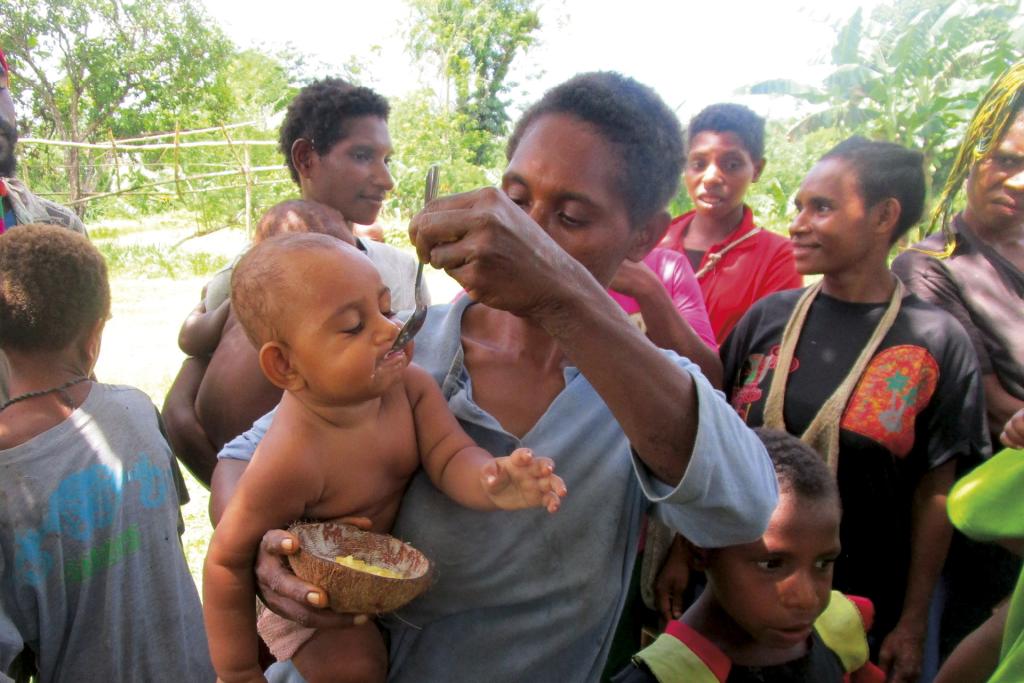
World Vision joins the cause
World Vision International (WVI) has signed a three-year Memorandum of Understanding (MoU)
with Food Plant Solutions (FPS).
For a small Tasmanian-born Rotary initiative to be recognised at this level – by one of the world’s largest humanitarian organisations – is extraordinary. But more importantly, it’s essential.
Malnutrition is one of the biggest preventable threats to children under five. Families need solutions that are practical, local, affordable, and climate resilient. That’s exactly where FPS and World Vision align.
“Food Plant Solutions offers an excellent suite of tools and resources that perfectly complement World Vision’s food-based approaches in over 20 countries,” said WVI Global Director for Health and Nutrition Dan Irvine. “Together, we’re going to bring local food solutions to the plates of needy children around the world.”
This MoU is more than just an agreement. It’s a major step forward in how we tackle child malnutrition, together.
To read WVI’s full announcement, visit wvi.org/nutrition/world-vision-and-food-plant-solutions
If you’re involved in Rotary projects where nutrition, food security or community resilience matter, email: info@foodplantsolutions.org

Related news
Nourishing mothers, nurturing futures
Rotary nutrition support helps expectant mothers in rural Bangladesh give babies a healthier start.
Healing hearts across India
Wyndham Rotary’s global partnership funded lifesaving heart surgery for children in need across India.
Rêves de Gosse lands in Nouméa
Rêves de Gosse united Rotary and partners to give children inclusion, joy and their first flight.