The women who changed Rotary
PICTURED: Sylvia Whitlock paved the way for women in Rotary when she became the first female Rotary club president in 1987.
Once excluded from membership, women are now leading Rotary at every level, reshaping the organisation through service, courage and a commitment to opening doors for the next generation.
Words Juliet Potter. PR, Media & Communications Manager.
For almost 80 years, women could support Rotary. They organised fundraisers, volunteered behind the scenes and championed community causes, but they couldn’t become members.
Today, women lead Rotary clubs, govern districts, chair regional councils and sit on Rotary International’s Board of Directors. Across Australia, New Zealand and the Pacific, they’re helping shape the future of one of the world’s largest humanitarian organisations – a remarkable shift for an organisation founded in 1905 as a professional association for businessmen.
When lawyer Paul Harris founded Rotary in Chicago, US, membership reflected the social norms of the day. Leadership remained exclusively male for decades, while women who wanted to serve largely did so through organisations such as Inner Wheel, supporting Rotary’s humanitarian work from outside the organisation itself.
Rotary International Director Jennifer Scott AM believes the journey towards inclusion is one of Rotary’s defining stories.
“There is quite an amazing history,” she says.
She points to the landmark legal challenge brought by the Rotary Club of Duarte in California, which reached the United States Supreme Court in the late 1980s. The decision that Rotary clubs could no longer exclude women from membership changed the organisation forever.
Yet Jennifer says an important part of that story is often forgotten.
“It was funded and action taken on behalf of women in the Rotary Club of Duarte by the men in the club,” she says.
It is a reminder that the push for women to join Rotary wasn’t driven by women alone. Many male Rotarians were already arguing the organisation would be stronger by welcoming women as members, and they played a pivotal role in making that change happen.
For Rotary South Pacific Chair Jennie Herring, though, that history wasn’t something she learnt from a book. She lived through the final stages of it.
“It was hard as you moved up the ranks because there was always the thought that as a female you had to prove yourself all the time,” she says.
Leadership was never Jenni’s goal. After more than a decade running her own business, she joined the Rotary Club of Otahuhu, NZ, looking for friendship and another way to give back once her children had grown up.
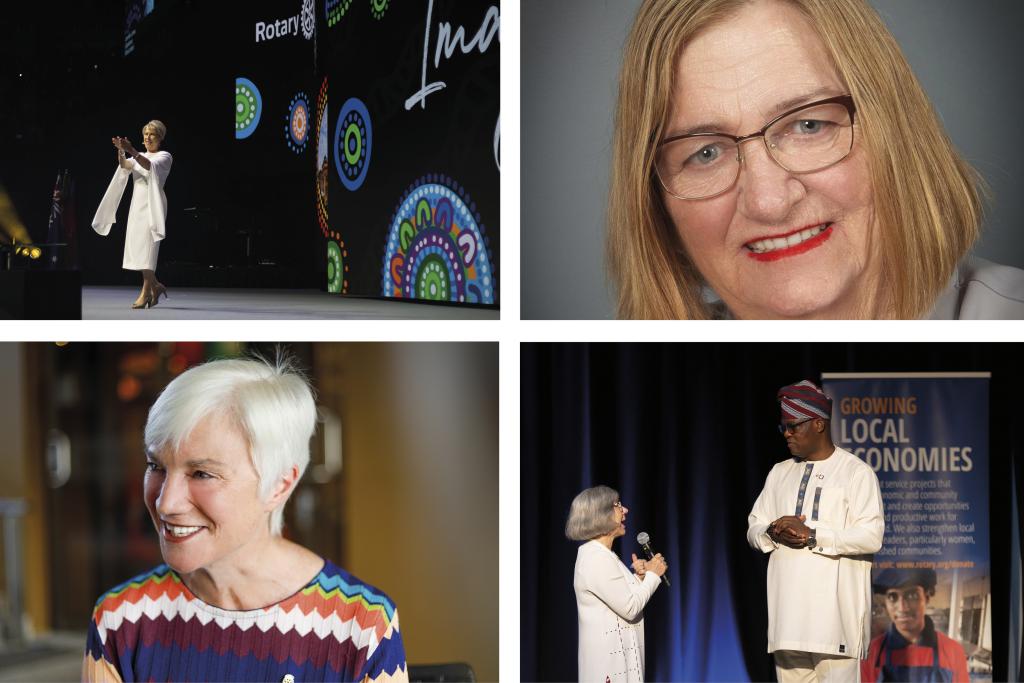
PICTURED FROM LEFT TO RIGHT: Jennifer Jones served as Rotary International President in 2022-23, the first female to be selected for the role in the organisation’s then 117-year history. / Rotary South Pacific Chair Jennie Herring says Women aren’t just part of Rotary’s future, they are shaping it, leading it and redefining what Rotary can be for the next generation. / Jessie Harman served as the first female Rotary International Director from Zone 8 in 2021-23. She is currently chair of Rotary Foundation Australia. / Jennifer Scott, of the Rotary Club of Central Blue Mountains, NSW, is the current Rotary International Director for Zone 8, covering Australia, New Zealand and the Pacific Islands.
“To join a club with 45 members was very overwhelming. I was shy and couldn’t speak publicly. I never had any aspirations other than being a Rotarian and was not even sure what that meant,” she says. “I joined for friendship and also to serve my community.”
At the time there were only five women in the club. Jennie says the Rotarians themselves welcomed her warmly, although not everyone was convinced women belonged.
“The Rotarians, both male and female, made me feel welcome. However, the wives of the Rotarians thought the women only joined Rotary to find a husband, or possibly take theirs,” she laughs.
Like many organisations steeped in tradition, Rotary didn’t change overnight. Acceptance came gradually as more women stepped into leadership and demonstrated the value they brought.
“When women first joined Rotary there was some resistance until the men realised the workload women could do,” Jennie says. “The acceptance of women over the past two decades has increased over time. As women leaders emerged across business and professional sectors, more and more found their way into Rotary.”
That change has unfolded alongside a broader shift in volunteering. Despite increasing financial pressures, Australians continue to give their time generously, with more than 9.5 million people volunteering formally, informally or both during 2025. Volunteers contributed more than 618 million hours through organisations, a significant increase on 2020 despite ongoing cost of living pressures, while women continue to volunteer formally at a slightly higher rate than men, particularly those aged between 35 and 54.
The way people volunteer is changing too. More people are looking for purpose, flexibility and genuine impact rather than committing to one organisation for life, and Jennie believes Rotary has recognised that.
“People think Rotary is old fashioned, but the truth is it’s transforming faster than they realise,” she says. “Rotary isn’t stuck in the past. We’re building the future. We just need more awareness to get this message out to the masses.”
While some of Rotary’s traditional image still lingers, particularly among older generations, Jennie believes today’s organisation reflects the communities it serves.
“With some of the older members, yes, but not with the younger members,” she says. “Society has changed, and Rotary must change with it. Today, our leaders come from every walk of life, from small business owners and teachers to managers and receptionists. Leadership isn’t about title anymore. It’s about service, passion and impact.”
She believes that’s especially important for younger women, who are looking for opportunities to volunteer in ways that fit around modern life.
“Younger women want purpose, flexibility and real impact and Rotary must offer all three. E-clubs, action groups and cause-based projects are how we meet younger women where they are.”
Jennie says she didn’t truly appreciate Rotary’s scale until she attended her first Rotary International Convention in Brisbane in 2003. Working with The Rotary Foundation only reinforced that perspective.
“It was the moment I saw Rotary beyond the club, beyond the district, and truly understood our global impact,” she says. “I was totally in awe of the Rotarians who gave so generously to support the work of The Rotary Foundation. The dedication of those who worked tirelessly for the Foundation was inspiring.
“Women aren’t just part of Rotary’s future, they are shaping it, leading it and redefining what Rotary can be for the next generation.”
Asked what she would say to the women who fought to make Rotary more inclusive, her answer comes without hesitation.
Thank you for your courage. You didn’t just open the door for yourselves; you opened it for all of us who came after you. You challenged a system that wasn’t ready for you, and you changed Rotary forever. Because of you, we get to lead, to serve and to shape the future of this organisation in ways you could only imagine at the time. Your determination didn’t just make Rotary more inclusive, it made Rotary better.”
Despite rising to one of Rotary’s most senior leadership roles, Jennie says the greatest gift the organisation has given her isn’t a title.
“Rotary has given me the confidence to back myself, to know that if I set my mind to something, I can do it. It’s taught me to speak with clarity and courage, and it’s given me lifelong friendships with people I never would have met if Rotary hadn’t brought us together.”
More than a century after Rotary was founded as an organisation for businessmen, one of its greatest strengths is that the women who once stood outside its doors are now helping hold them open for the next generation.